

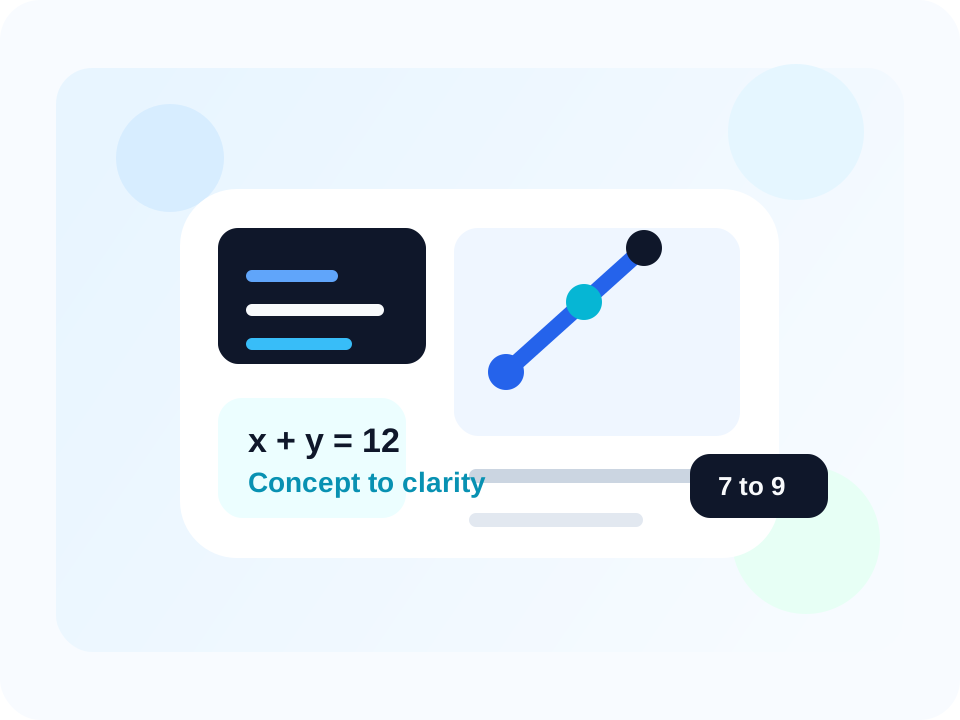
Students often encounter the same mathematical idea presented in several different forms throughout IB Mathematics. A relationship might appear as an equation in one question, a graph in another, a table of values elsewhere, and sometimes even as a written description. For many learners, this can feel like studying multiple topics when, in reality, the underlying mathematics is often the same.
This emphasis on multiple representations is a deliberate feature of the IB Mathematics curriculum. It reflects the belief that genuine mathematical understanding involves seeing connections between different ways of expressing the same concept.
Consider a simple relationship between two variables. That relationship can be represented algebraically through an equation, visually through a graph, numerically through a table, or verbally through a description of how one quantity changes in relation to another. Each representation highlights different aspects of the same mathematical idea.
An equation often provides precision and allows calculations to be performed efficiently. A graph reveals patterns, trends, and overall behavior that may be difficult to notice from symbols alone. A table can make numerical relationships easier to observe, while a verbal explanation helps connect mathematics to meaning and context.
Students who can move comfortably between these forms tend to develop a deeper understanding of mathematics. Instead of viewing concepts as isolated procedures, they begin recognizing the relationships that connect different mathematical perspectives.
One reason IB Mathematics values multiple representations is that mathematics itself is a language. Just as ideas can be expressed through speech, writing, diagrams, or images, mathematical ideas can also be communicated through different forms depending on the purpose.
Different representations are useful for different tasks. A graph may be ideal for identifying trends, while an equation may be better suited for making predictions. A table might help organize data, while a written explanation can clarify interpretation. Understanding when and why each representation is useful is an important mathematical skill.
Assessment tasks frequently require students to translate between representations. They may be asked to sketch a graph from an equation, determine an equation from a graph, interpret information from a table, or explain the meaning of mathematical results in words.
These translation skills reveal whether students truly understand the underlying concept. Memorizing procedures is often insufficient because the same idea can appear in unfamiliar forms. Students must recognize the connection beneath the surface presentation.
Another reason for using multiple representations is accessibility. Different students often find different forms more intuitive. Some learners think visually and understand concepts quickly through graphs, while others prefer symbolic expressions or numerical patterns.
By exposing students to multiple representations, the curriculum encourages flexibility in thinking. Students learn that there is often more than one way to approach a mathematical situation and that each representation can provide valuable insight.
Real-world applications also rely heavily on representation changes. Scientists may collect numerical data, organize it in tables, display it graphically, develop mathematical models, and then communicate findings through written reports. Mathematics frequently moves between forms in professional environments.
Technology has made representation skills even more important. Modern software can generate graphs, perform calculations, and analyze data rapidly. However, meaningful interpretation still requires understanding how different representations relate to one another.
Students sometimes struggle because they become comfortable with only one representation of a topic. For example, they may know how to manipulate equations but find graphs challenging, or they may interpret graphs well but struggle to express relationships algebraically.
Developing balance across representations helps address these weaknesses. When students practice viewing concepts from multiple perspectives, they often discover connections that strengthen overall understanding.
Teachers frequently encourage students to ask whether a concept can be represented differently. Drawing a graph, creating a table, or describing a relationship in words can reveal insights that are not immediately obvious from equations alone.
Past paper questions often illustrate the importance of this skill. Many examination tasks require students to switch between forms of representation while maintaining an understanding of the underlying mathematics.
Working with an experienced IB Mathematics tutor can help students build confidence in these transitions. Guided practice often makes it easier to recognize how different representations relate and why each one matters.
At Maths Bodhi, Ajay Vatsyayan helps students understand the connections between equations, graphs, tables, diagrams, and verbal explanations. This broader perspective strengthens conceptual understanding and prepares students for the variety of question styles encountered in IB assessments.
Ultimately, IB Mathematics uses multiple representations because mathematics is far more than a collection of formulas. It is a system of ideas that can be expressed in different ways depending on the situation. Students who learn to navigate these representations develop a deeper, more flexible understanding of mathematics and become better equipped to solve problems, interpret information, and communicate mathematical thinking effectively.
Book a free demo class with Ajay Vatsyayan Sir for personalized IB MYP and IB DP Mathematics home or online tutoring in Gurugram.