

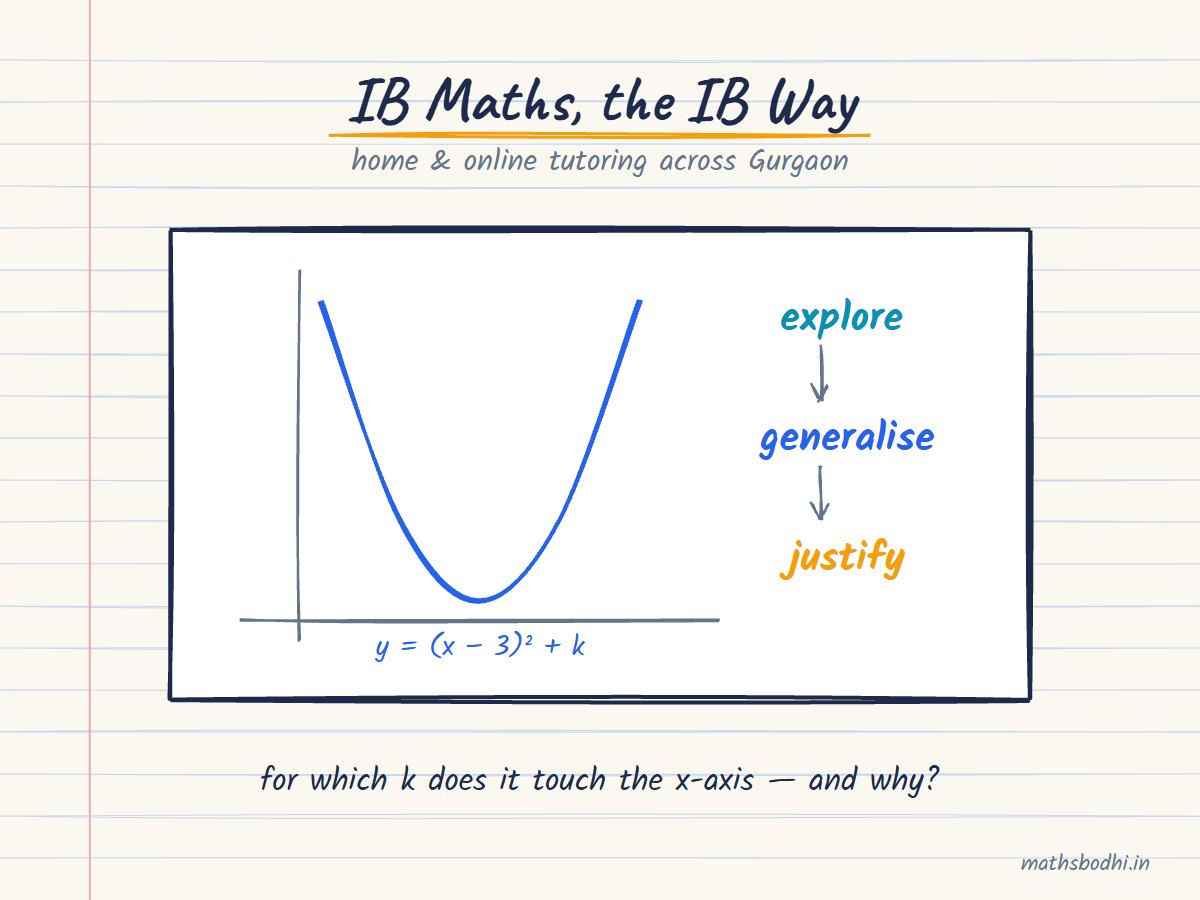
Parents who move their child from a CBSE or ICSE school to an IB school often notice the same thing: maths homework looks different. There are fewer drill exercises and more questions that start with "investigate", "justify" or "explain why". Many tutors respond by teaching IB students the way they teach board exams – more worked examples, more formulas. That rarely works, because the IB does not assess maths that way.
This post explains what "the IB way" means in maths, and how we at Maths Bodhi try to plan home and online sessions around it for MYP and DP students in Gurgaon.
What the IB actually assesses
The clearest guide to how IB maths should be taught is how it is marked.
- In the MYP, every unit is assessed on four equally weighted criteria: A – knowing and understanding, B – investigating patterns, C – communicating, and D – applying mathematics in real-life contexts. Only one of the four is mostly about getting correct answers to familiar questions.
- In DP Analysis and approaches (AA), the IB puts "strong emphasis on the ability to construct, communicate and justify correct mathematical arguments".
- In DP Applications and interpretation (AI), the IB emphasises "the meaning of mathematics in context", and all external assessment involves technology.
- In both DP courses, the internal assessment (IA) is an independent exploration worth 20% of the grade. In the new course from 2027, it is marked on problem specification, abstraction, computation and interpretation.
A student can know every formula and still score poorly on Criteria B, C and D, or on the IA. Teaching "the IB way" means teaching for all of it.
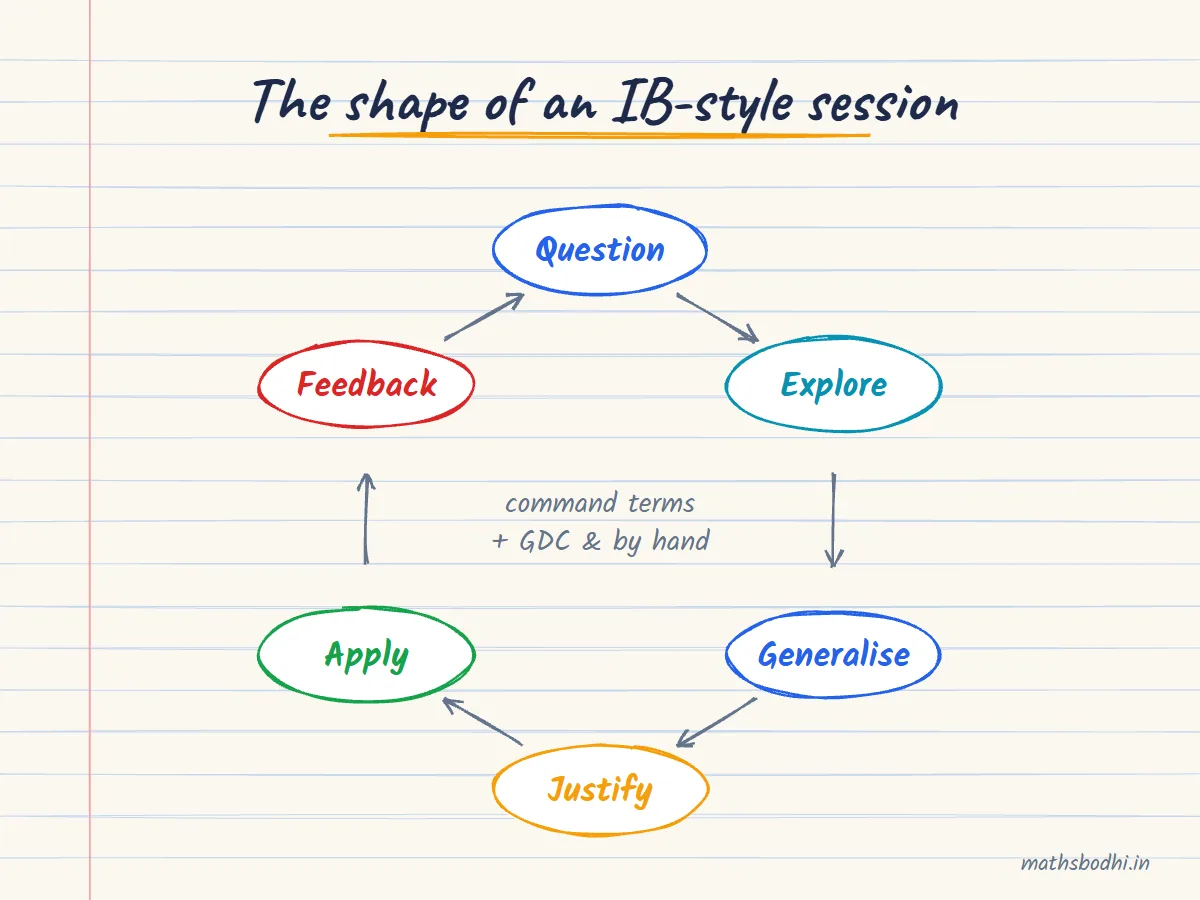
How we shape a session
Every student is different, so there is no fixed script. But most sessions we plan for IB students follow a recognisable shape.
1. Start with a question, not a formula
Instead of opening with "today we learn the quadratic formula", we start with something to investigate: for which values of k does this parabola touch the x-axis? The student tries a few values, sketches, and notices a pattern before any formula appears. This builds the habit Criterion B rewards and makes the formula something the student understands rather than memorises.
2. Explore with technology – and without it
IB students need both skills. AI papers and AA Papers 2 and 3 require a graphing calculator; MYP on-screen exams provide an on-screen graphing calculator; AA Paper 1 allows no calculator at all. So we use a graphing tool to explore ideas quickly, then check that the student can reproduce the key steps by hand. Our calculator guide covers which device to use.
3. Generalise and justify
Once a pattern is found, the next question is "will this always work – and why?" This is where proof, counterexamples and clear notation come in. We ask students to write the justification in full sentences and correct notation, because that is what Criterion C and the DP mark schemes reward. Related reading: why showing reasoning matters more than memorising solutions and why counterexamples are powerful.
4. Speak the language of command terms
IB questions use command terms – state, show that, hence, justify, sketch, determine – each of which asks for a specific kind of answer. A student who writes a full derivation for "state", or skips steps on "show that", loses time or marks. We practise reading the command term first and answering exactly what it asks. See our guide to IB command terms.
5. Apply it to something real
Criterion D in MYP and the whole of the AI course reward applying maths to real contexts – and recognising when a model's assumptions break down. We bring in contexts students know: comparing data plans, the shape of a cricket ball's path, or traffic on a familiar road. Then we ask what the model ignores. Related: why IB uses real-world contexts in exam questions and why mathematical modelling matters.
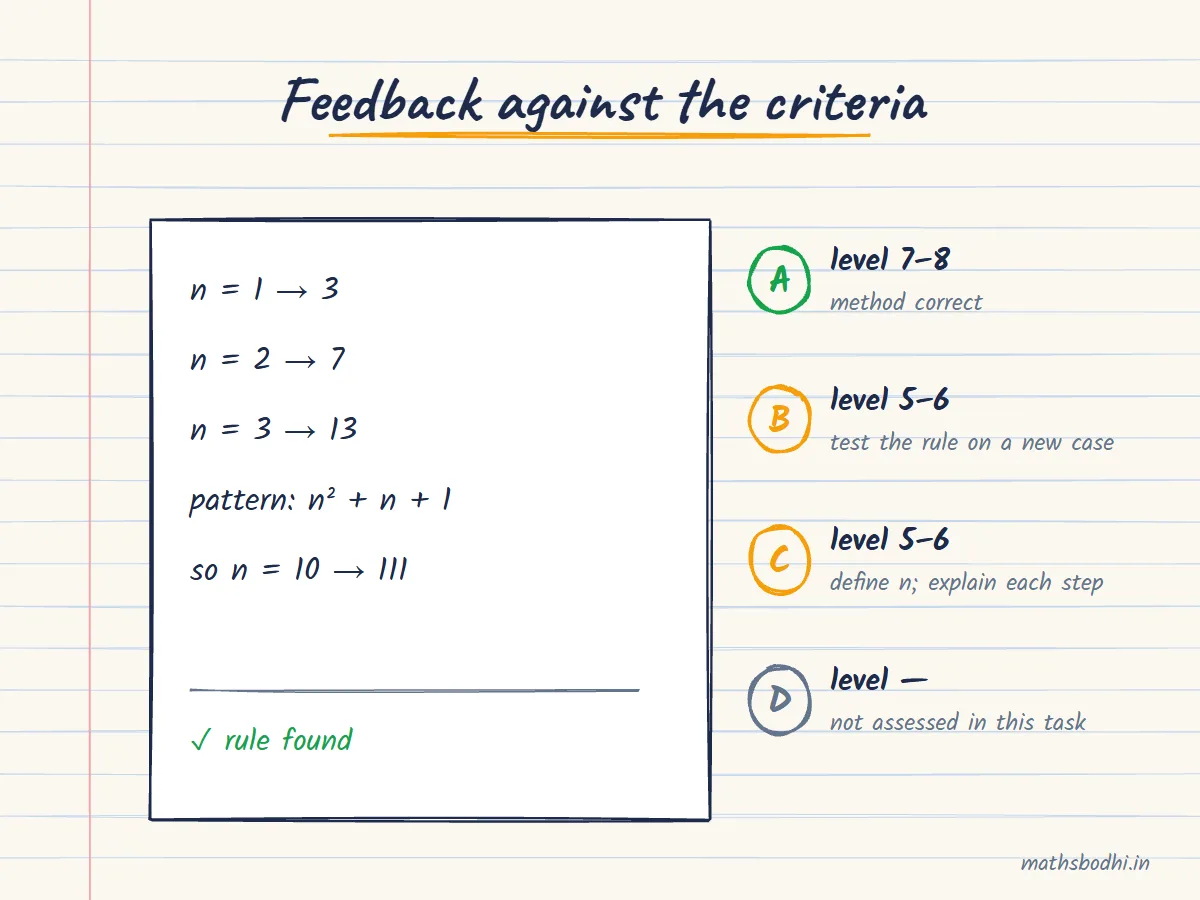
6. Feedback against the criteria
When we mark a student's work, we try to mark it the way their teacher or examiner will – against the MYP criteria or the DP mark scheme – and tell them which level descriptor or which mark they missed and why. "Good work" helps no one; "you found the pattern but didn't test it on a new case, so this is a 5–6 on Criterion B, not a 7–8" does. Our guides to Criterion A, B, C and D explain the levels.
How it differs between MYP and DP
- MYP (years 1–5): more time on investigation and communication, building the habits that Criteria B, C and D reward. In MYP 4 and 5 we also prepare students for the on-screen exam if their school uses it, and help them choose between Standard and Extended maths.
- DP AA: more emphasis on rigorous algebra, calculus and proof, and on calculator-free fluency for Paper 1.
- DP AI: more emphasis on modelling, statistics and confident, sensible use of the graphing calculator.
- The IA (both courses): we guide the student's own exploration – helping them choose a workable question and understand the criteria – without writing it for them. The IA must be the student's own work.
What we do not do
- We do not complete IA drafts, school projects or assessed tasks for students.
- We do not teach IB students as if they were preparing for a board exam with a fixed question bank.
- We do not promise grades. We can promise a plan, honest feedback and teaching that matches how the IB assesses.
IB maths home tutoring in Gurgaon
Maths Bodhi tutors teach IB maths at home across Gurgaon – including Golf Course Road, the DLF phases, Sohna Road, and Sectors 43, 54, 56 and 57 – and online for families outside Gurgaon. Home sessions suit students who focus better with someone beside them; online sessions with a shared whiteboard suit busy timetables. See home vs online IB tuition if you are deciding.
- Find a tutor near you: IB maths home tutor in Gurugram, Golf Course Road, DLF Phase 4, Sector 43, Sector 54, Sector 56.
- Explore our IB maths home tutor page, the MYP and DP overviews, or online IB maths tuition.
- Meet Ajay Vatsyayan, read questions to ask in a demo class, then book a demo.
Assessment facts verified against IB subject briefs by the Maths Bodhi team (October 2026). Teaching approach described and reviewed by Ajay Vatsyayan.
Frequently asked questions
- What does teaching IB maths "the IB way" mean?
- It means teaching for how the IB assesses: not only correct answers but investigating patterns, communicating reasoning, applying maths to real contexts and, in DP, constructing and justifying arguments and completing an independent exploration.
- Do Maths Bodhi tutors teach both IB MYP and DP maths?
- Yes. Our IB tutors work with MYP students (years 1–5) and DP students in both Analysis and approaches and Applications and interpretation, at SL and HL.
- Will a tutor write or edit my child's IB maths IA?
- No. The IA must be the student's own work. A tutor can help a student understand the criteria, choose a workable question and strengthen the underlying maths, but does not write or rewrite the exploration.
- Do you offer IB maths home tuition across Gurgaon?
- Yes. Maths Bodhi tutors teach at home across Gurgaon, including Golf Course Road, the DLF phases, Sohna Road and Sectors 43, 54, 56 and 57, and online for families elsewhere.