

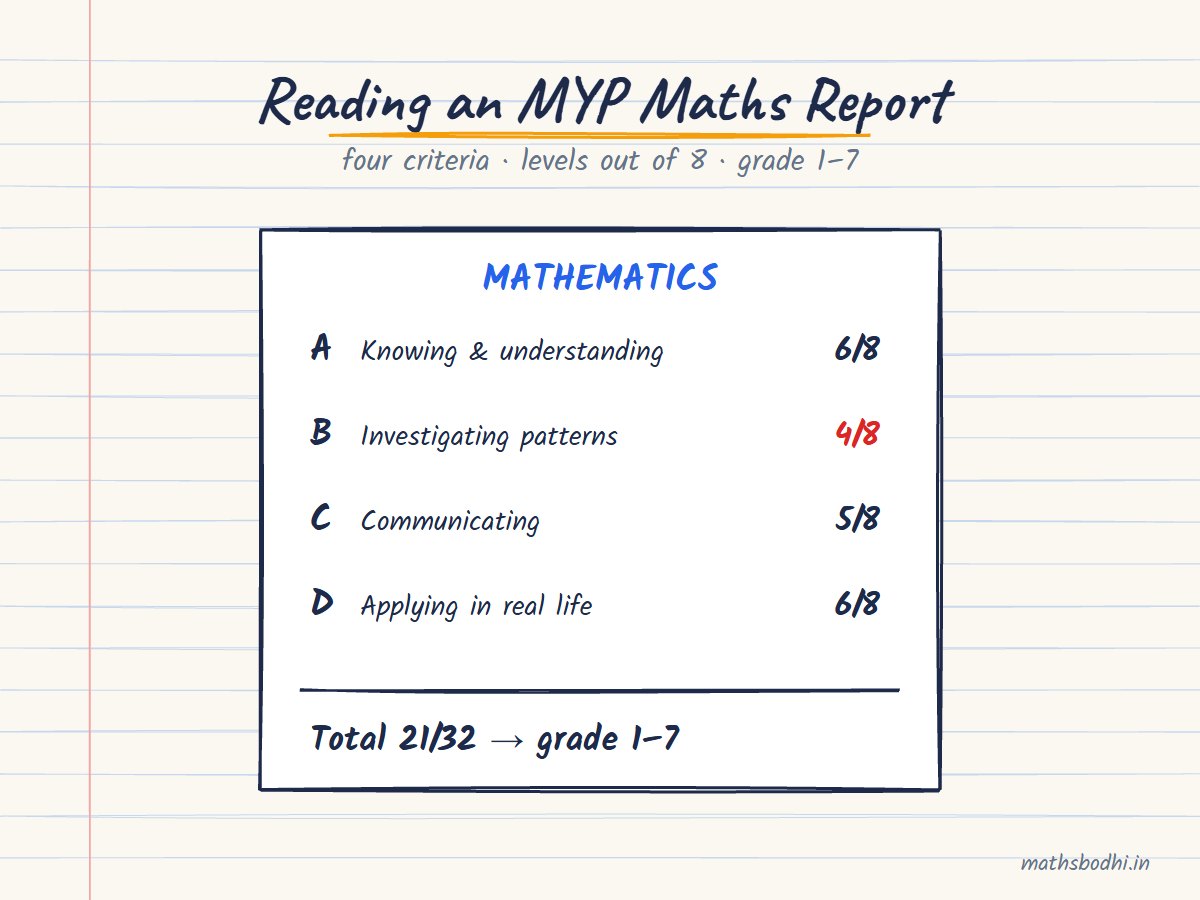
The first MYP report card often confuses parents who grew up with percentages. Instead of "84%", the maths section shows four letters, a number out of 8 against each, and a final grade from 1 to 7. A child can score well on one criterion and poorly on another in the same term, and the overall grade may not match what you expected from their test papers.
This guide explains what each part of the report means, how the numbers fit together, and what to do when one criterion is holding a grade back.
The four criteria
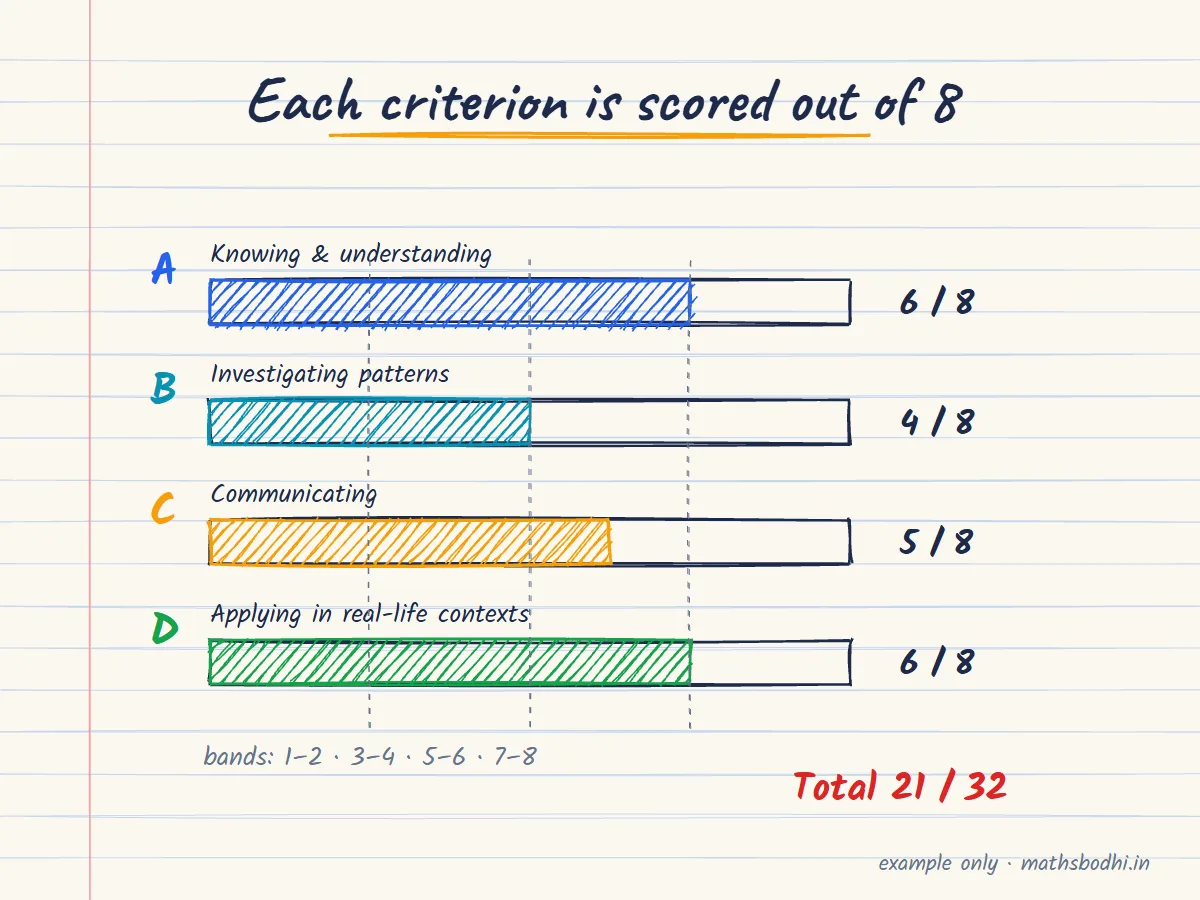
The IB's MYP mathematics brief says each objective "corresponds to one of four equally weighted assessment criteria". They are:
- Criterion A – Knowing and understanding. Selecting and applying the right mathematics to solve problems, in familiar and unfamiliar situations. This is the closest to a traditional maths test.
- Criterion B – Investigating patterns. Exploring a situation, finding a pattern, describing it as a general rule, and verifying or justifying it.
- Criterion C – Communicating. Using correct mathematical language, notation and representations, and presenting reasoning in a clear, logical order.
- Criterion D – Applying mathematics in real-life contexts. Turning a real situation into a mathematical model, solving it, and judging whether the answer makes sense in context.
Because the four criteria are equally weighted, a student who is excellent at calculation (A) but rarely explains their work (C) or struggles to generalise (B) cannot reach the top grades. This is the single most common reason a "good at maths" student gets a surprising MYP grade.
What the levels out of 8 mean
Each criterion is scored on a scale up to 8, divided by the IB into four bands: 1–2, 3–4, 5–6 and 7–8. Each band has a written descriptor – for example, in many criteria the lower bands describe work that is attempted with help or in simple situations, while the top band describes work that is thorough, accurate and applied to challenging or unfamiliar situations.
Teachers judge a piece of work against those descriptors, not against a percentage. So a test with "35 out of 40" correct answers does not automatically become a 7 or 8 on Criterion A – the level depends on which descriptor the work best matches, including how complex the problems were.
For subject-specific advice on moving up each scale, see our guides to Criterion A, Criterion B, Criterion C and Criterion D, or the all-in-one criteria guide.
From levels to the 1–7 grade
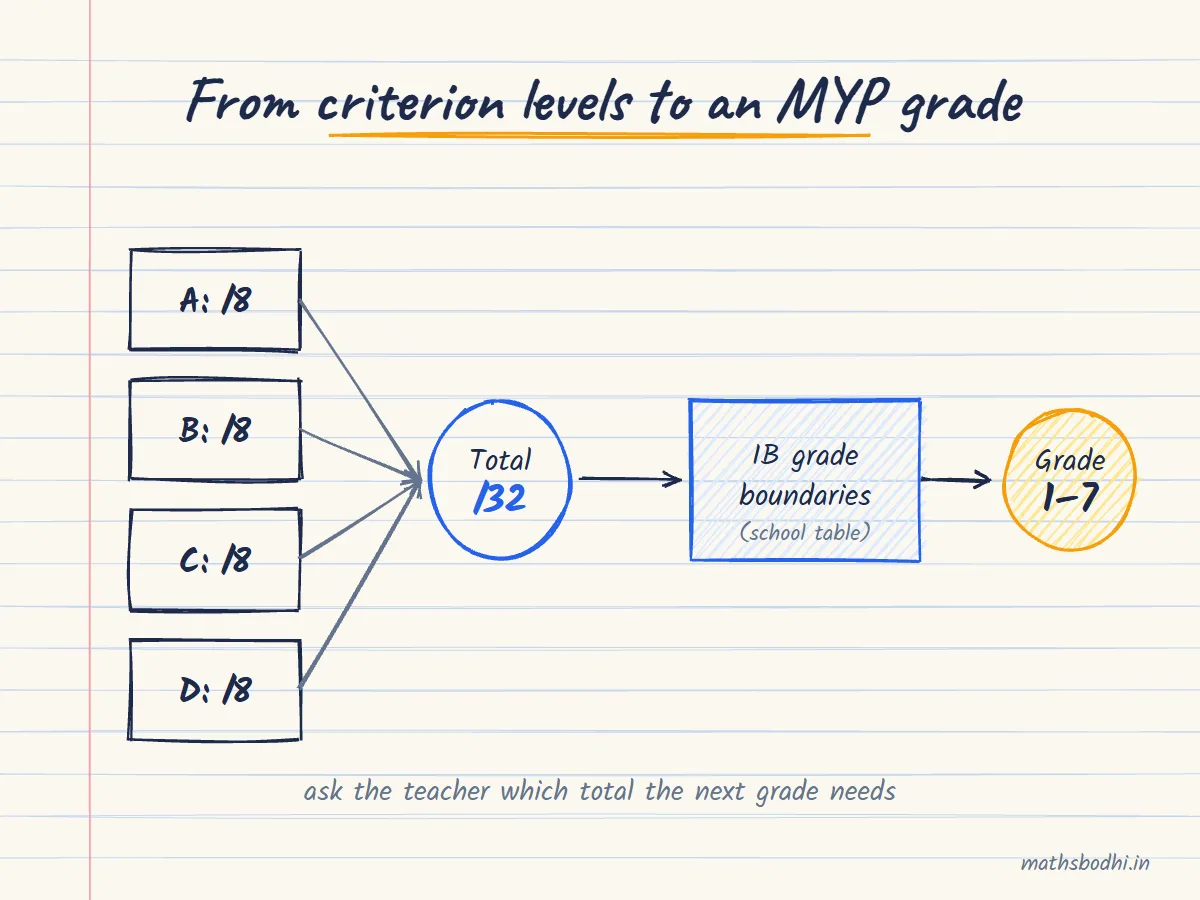
At reporting time, the teacher decides a final level for each criterion, based on the student's work across the period. The four levels are added up to a total out of 32. That total is then converted to the final MYP grade from 1 to 7 using grade boundaries set by the IB.
The IB publishes these boundaries to schools in its MYP guidance for teachers, not on its public website, so we do not reproduce a table here. If you want to know which total your child needs for the next grade, ask the maths teacher or MYP coordinator – they use the official table.
The MYP on-screen exam and certificate
In MYP 5, some schools register students for the optional eAssessment. For maths, this is a 2-hour on-screen exam (in Standard or Extended mathematics) held in May or November. It has three tasks of roughly 31–35 marks each, with Criterion C assessed across all three. See our guides to Standard vs Extended maths and preparing for MYP eAssessment.
According to the IB:
- eAssessment results show a grade from 1 to 7 for each subject.
- For the MYP certificate, the maximum total is 56, and students need at least 28 points, with a grade of 3 or higher in each required eAssessment component.
- Results are released on 1 August for May exams and on 1 February for November exams.
What to do when one criterion is low
- Look at the criterion, not just the grade. A 4 on Criterion B with 6s elsewhere is a specific, fixable problem.
- Ask the teacher for one piece of marked work that shows the issue, and the descriptor for the next band up.
- Practise that skill directly. For Criterion B, that means investigation tasks where the student must state and test a general rule. For Criterion C, it means writing full solutions with clear notation. For Criterion D, it means checking whether an answer is reasonable in its real context.
- Do not chase harder content to fix a communication or investigation gap. More advanced topics will not lift Criterion B or C.
If maths feels harder in MYP than it did before, that is common – see why MYP maths is difficult for many students.
Year-by-year support
Expectations rise each year, and the criteria descriptors are applied to more complex work in MYP 4 and 5. Our year pages explain what changes: MYP 1, MYP 2, MYP 3, MYP 4 and MYP 5.
In Gurgaon: MYP maths help at home or online
Maths Bodhi tutors work with MYP students at home across Gurgaon – including Golf Course Road, the DLF phases, Sohna Road and Sectors 43, 54, 56 and 57 – and online for families elsewhere. We mark practice work against the same criteria the school uses, so students know exactly which band they are in and what moves them up. Read how our tutors teach IB maths, see the IB MYP maths overview, find an IB maths home tutor in Gurugram, or book a demo class.
Facts verified against the IB's MYP mathematics brief and MYP assessment pages by the Maths Bodhi team (October 2026). Advice reviewed by Ajay Vatsyayan.
Frequently asked questions
- What are the four MYP maths criteria?
- Criterion A is knowing and understanding, B is investigating patterns, C is communicating, and D is applying mathematics in real-life contexts. The IB weights all four equally.
- How is the MYP maths grade from 1 to 7 calculated?
- Each of the four criteria gets a final level out of 8. The levels are added to a total out of 32, which the school converts to a grade from 1 to 7 using grade boundaries the IB provides to schools.
- Why is my child's MYP maths grade lower than their test scores suggest?
- The four criteria are weighted equally, so strong calculation (Criterion A) cannot make up for weak investigation (B), communication (C) or real-life application (D). Levels also depend on how complex the work is, not just the percentage correct.
- How many points are needed for the MYP certificate?
- The maximum total is 56. Students need at least 28 points, with a grade of 3 or higher in each required eAssessment component.
- When are MYP eAssessment results released?
- On 1 August for May examinations and on 1 February for November examinations.