

Swedish university maths, sessions in English
University maths tutor online for students in Sweden: Ajay Vatsyayan
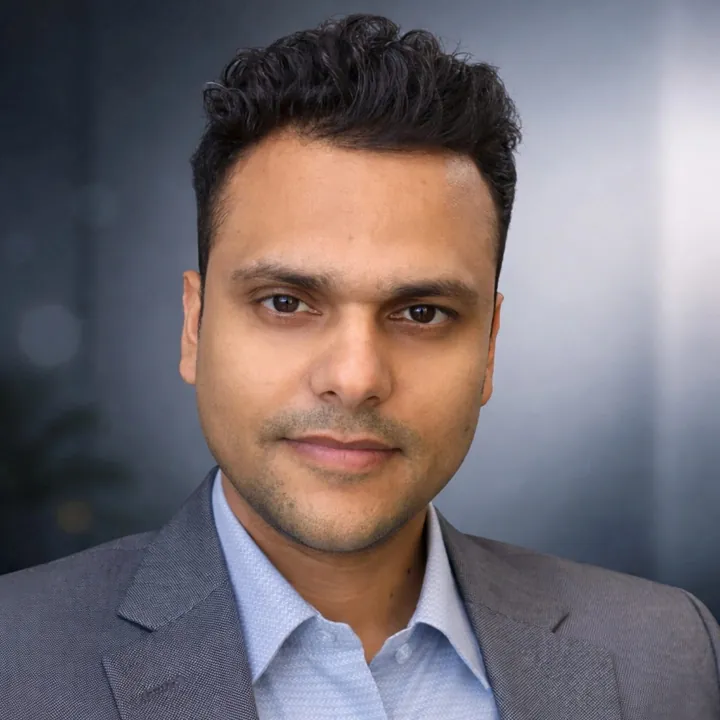
Ajay Vatsyayan (M.Tech, 14+ years teaching maths) teaches university maths online, in English, to students at Swedish universities, using their own course plan, exercises and old exams. Sessions cover calculus in one and several variables, linear algebra and differential equations, at times that fit a Swedish afternoon or early evening.
1:1
Online sessions
English
Teaching language
+4 h 30
IST ahead of Sweden in winter (CET)
My Master's programme assumes linear algebra and multivariable calculus that I last studied years ago.
My maths course is taught in Swedish, and I would understand the hard parts faster in English.
I missed the pass on the written exam and the re-exam is my next chance.
Language first
Swedish-taught courses, sessions in English
Most first-year maths at Swedish technical universities is taught in Swedish. Chalmers gives Swedish as the teaching language on the syllabi for its first-year courses TMV137, TMV216 and MVE465, and KTH's SF1625, SF1624 and SF1626 are core courses in its Swedish-taught engineering programmes. We have not found an English-taught first-year maths course at either university, so this page does not claim one.
Sessions with Ajay are in English. The mathematics does not change with the language: a determinant or a Taylor polynomial works the same way in Swedish. If your exercises and old exams are in Swedish, send them along with an English version of the questions (a machine translation is fine), and keep the Swedish terms next to the English ones in your notes so you recognise them on exam day.
These sessions are designed for three groups: international Master's students who must refresh the calculus and linear algebra their programme assumes, exchange students taking a Swedish maths course, and Swedish-speaking students who simply want a second explanation in English.
Course map
KTH and Chalmers first-year maths, topic by topic
The table follows the topics listed on the official course pages, with the point in each topic where students most often lose marks.
| Course | Topic | Where marks are lost |
|---|---|---|
| KTH SF1625 Calculus in One Variable | Functions, limits and continuity | Limits guessed instead of worked out with standard limits or Taylor expansions |
| SF1625 | Derivatives and their applications | Endpoints and sign changes missed in max–min problems |
| SF1625 | Integrals | Limits not changed after a substitution; partial fractions set up wrongly |
| SF1625 | Sequences, series and Taylor series | Too few terms kept in an expansion, so the limit comes out wrong |
| SF1625 | Differential equations | The particular solution guessed in the wrong form |
| KTH SF1624 Algebra and Geometry | Vectors, matrices and linear equations | Row-reduction slips and parametric solutions written unclearly |
| SF1624 | Determinants | Row operations that change the determinant without adjusting for it |
| SF1624 | Vector spaces and linear transformations | Kernel and image confused; the matrix of a map written in the wrong basis |
| SF1624 | Eigenvalues and orthogonality | Eigenvectors not checked; projections computed with a basis that is not orthogonal |
| KTH SF1626 Calculus in Several Variables | Limits, partial derivatives and linear approximation | Deciding a limit exists after testing only one path |
| SF1626 | Multiple integrals | The factor r missing in polar coordinates; integration limits in the wrong order |
| SF1626 | Vector calculus: Green, divergence and Stokes | Orientation of the curve or surface ignored |
| Chalmers TMV137 and MVE465 | Integration, power series, complex numbers (MVE465), differential equations, numerical methods in MATLAB | Correct theory, but no sanity check on the numerical answer |
| Chalmers TMV216 | Matrices, linear transformations, eigenvectors, bases and dimension, with Python | Treating the computer part as separate from the theory |
Course codes
The courses this page is built around
Each course below is worth 7.5 credits. Titles are the official English ones; Swedish titles appear only where we read them on the official course page.
| University | Code | English title | Swedish title | Notes |
|---|---|---|---|---|
| KTH | SF1625 | Calculus in One Variable | Envariabelanalys | Written exam (TEN1, 7.5 credits) |
| KTH | SF1624 | Algebra and Geometry | Not stated here | Written exam (TEN1, 7.5 credits) |
| KTH | SF1626 | Calculus in Several Variables | Not stated here | Written exam (TEN1, 7.5 credits) |
| Chalmers | TMV137 | Calculus in one variable | Matematisk analys i en variabel | Year 1 in Electrical Engineering and Biomedical Engineering; taught in Swedish |
| Chalmers | TMV216 | Linear algebra | Linjär algebra | Year 1 in Computer Science and Engineering; taught in Swedish |
| Chalmers | MVE465 | Linear algebra and calculus | Linjär algebra och analys fortsättning | Taught in Swedish; includes numerics in MATLAB |
KTH describes the TEN1 module as a “written exam, possibly with the possibility of continuous examination”, so check your own course page for any continuous-assessment option. Other Swedish universities use their own codes; send yours and sessions follow that course.
Grades and exams
How grading and re-exams work
KTH generally uses a seven-grade scale: A, B, C, D, E, Fx and F. A to E are passing grades, with A the highest, and Fx means the result is close to a pass and may be upgraded to one. Exams at KTH are usually connected to individual courses rather than held at the end of the semester, each study period ends with an exam period, and you register through Ladok for students. If you do not pass, you will normally get another opportunity at a re-exam.
Chalmers grades these courses Pass with distinction (5), Pass with credit (4), Pass (3) or Fail. The written exam is graded U, 3, 4 or 5, and computer labs are graded G or U. For TMV137 and MVE465 the written exam grade becomes the course grade, and both parts must be passed. Some courses offer optional bonus points from quizzes or tests.
For preparation, that means two things: practise from old exams for your course, because the written exam decides the grade, and treat the quizzes as checkpoints rather than extras.
Where it gets hard
Where students in Sweden usually get stuck
Some of the difficulty comes from the maths itself and some from the way the courses are organised:
- Pace. A course runs inside one study period, so a topic missed in week two is examined only a few weeks later, with little time to recover.
- Language load. Reading a Swedish problem and solving it at the same time doubles the work; many students lose time decoding the question rather than doing the maths.
- Taylor expansions in limits. Calculus in one variable expects you to expand to the right order; stopping a term short gives the wrong answer however good the method looked.
- Geometry inside linear algebra. Algebra and Geometry mixes lines, planes and projections with abstract vector spaces, and students strong on one side often neglect the other.
- Prerequisite gaps for Master's students. A programme in machine learning, control or finance may expect eigenvalues, gradients and multiple integrals from the first week.
Worked examples
Three exam-style questions from the first-year courses
One question in the style of each KTH course on this page. The numbers are ours; the topics come from the official course descriptions.
Calculus in one variable: a limit by Taylor expansion
Find the limit of (ln(1 + 2x) − 2x)/x² as x → 0.
- Use ln(1 + u) = u − u²/2 + u³/3 − … with u = 2x: ln(1 + 2x) = 2x − 2x² + (8/3)x³ − …
- Subtract 2x: ln(1 + 2x) − 2x = −2x² + (8/3)x³ − …
- Divide by x²: the expression equals −2 + (8/3)x − …
- As x → 0, every term after −2 tends to 0.
Answer: −2
Stopping the expansion at 2x leaves 0/x², which tells you nothing. Expand at least as far as the power of x in the denominator.
Algebra and geometry: eigenvalues and diagonalisation
A is the 2 × 2 matrix with rows (4, 1) and (2, 3). Find its eigenvalues and eigenvectors, and write A = PDP⁻¹.
- Characteristic polynomial: det(A − λI) = (4 − λ)(3 − λ) − 2 = λ² − 7λ + 10.
- Factorise: (λ − 2)(λ − 5) = 0, so λ = 5 or λ = 2.
- λ = 5: A − 5I has rows (−1, 1) and (2, −2), so −x + y = 0 and one eigenvector is (1, 1).
- λ = 2: A − 2I has rows (2, 1) and (2, 1), so 2x + y = 0 and one eigenvector is (1, −2).
- Check: A(1, 1) = (5, 5) = 5(1, 1), and A(1, −2) = (4 − 2, 2 − 6) = (2, −4) = 2(1, −2).
- Let P have columns (1, 1) and (1, −2), and let D = diag(5, 2). Then A = PDP⁻¹.
Answer: λ = 5 with eigenvector (1, 1); λ = 2 with eigenvector (1, −2); A = PDP⁻¹ with D = diag(5, 2).
Calculus in several variables: a double integral in polar coordinates
Evaluate ∬ e^(−(x² + y²)) dA over the disc D: x² + y² ≤ 4.
- Both the integrand and the region depend only on x² + y², so switch to polar coordinates: x² + y² = r², dA = r dr dθ, with 0 ≤ r ≤ 2 and 0 ≤ θ ≤ 2π.
- The integral becomes ∫ from 0 to 2π of ∫ from 0 to 2 of e^(−r²) r dr dθ.
- Inner integral, with u = r² and du = 2r dr: ∫ from 0 to 2 of r e^(−r²) dr = [−e^(−r²)/2] from 0 to 2 = (1 − e^(−4))/2.
- The outer integral multiplies this by 2π.
Answer: π(1 − e^(−4)) ≈ 3.084
Without the factor r in dA, the inner integral has no elementary antiderivative: a useful warning sign that something has gone wrong.
Time zones
Session times between Sweden and India
Sweden is on CET (UTC+1) in winter and CEST (UTC+2) in summer, switching on the last Sunday of March and the last Sunday of October. India stays on IST (UTC+5:30) all year, so it is 4 hours 30 minutes ahead of Sweden in winter and 3 hours 30 minutes ahead in summer.
In practice, 3:00 pm in Stockholm or Gothenburg is 7:30 pm in India in winter and 6:30 pm in summer, and 6:00 pm Swedish time is 10:30 pm in India in winter and 9:30 pm in summer. Afternoon and early-evening Swedish slots are the easiest to keep every week. Exact times are agreed by your time zone when you enquire.
How sessions work
How sessions run for students in Sweden
Everything happens online: a shared screen, your handwritten working on camera or a tablet, and notes you keep after each session.
1. Share your course page and old exams
Send the course code, a link to the course page, the current exercise list, two or three old exams and your exam date. Swedish documents are fine; add English versions of the questions if you can.
2. First session: find the real gap
Ajay works through a few short questions with you and watches each handwritten step. For Master's students this shows which first-year topics need rebuilding before the programme's own material makes sense.
3. Weekly sessions through the study period
One or two sessions a week, matched to the lecture plan, with Swedish and English terms side by side in your notes.
4. The exam period
The last weeks move to old exams under time limits, with feedback on how complete and clearly explained each written solution is, not just whether the final answer is right.
5. Re-exam or next course
If the exam did not go well, plan for the re-exam straight away while the material is fresh; if it did, look ahead to the next course.
Our usual approach
A six-week run-in to the written exam
For a student preparing for a first sitting or a re-exam, this is how we usually plan six weeks. It is our usual approach, not a promise, and a shorter runway simply means more sessions per week.
Weeks 1–2: rebuild the base
Definitions and standard methods for every topic on the course plan, starting with the gaps the diagnostic found.
Weeks 3–4: old exams by topic
Exam questions grouped by topic, so each method is seen in three or four different forms.
Week 5: full old exams
Complete papers under time limits, then a careful review of every lost mark.
Week 6: final checks
Short mixed questions and a one-page list of the formulas and steps you must not forget.
Fit
Who this suits, and who should look elsewhere
Online sessions from India suit some students in Sweden very well and others not at all.
Home tuition is available in Gurgaon (Gurugram). Students elsewhere in India and abroad learn with us online.
- Suits international Master's students whose programme assumes first-year calculus and linear algebra.
- Suits exchange students taking a Swedish maths course who want the ideas explained in English.
- Suits students on Swedish-taught programmes preparing for a re-exam.
- Does not suit anyone who needs teaching in Swedish: sessions are in English only.
- Does not suit students who want hand-ins, lab assignments or online quizzes done for them.
Academic integrity
Learning support, not assessed work
Ajay teaches, sets practice problems and reviews what you have written yourself. We do not complete graded hand-ins, computer-lab assignments, bonus quizzes or online tests, and we do not take written exams or re-exams for anyone. Swedish universities treat that as cheating, and it would leave you unprepared for the written exam, which is where the grade is decided.
If an exercise counts towards your grade, do it on your own and bring an ungraded exercise on the same topic to the session; Ajay will teach the method on that.
Study guides
Free guides for this course
Worked examples and exam advice from the Maths Bodhi team, topic by topic.
Related Ajay routes
Continue with the most relevant next page
University maths tutor online
Every university course area Ajay teaches.
Switzerland university maths online
For students at ETH Zurich, EPFL and other Swiss universities.
Linear algebra tutor online
Matrices, vector spaces and eigenvalues in depth.
Calculus 3 tutor online
Calculus in several variables and vector calculus.
Differential equations tutor online
First- and second-order ODEs and systems.
UK university maths online
For students at UK universities.
Guide: first-year maths at KTH and Chalmers
Courses, grading and the language question.
Book a demo session
Meet Ajay online before you decide.
Main Ajay profile
About Ajay Vatsyayan as a tutor.
FAQ
Questions students in Sweden ask about online maths sessions
Are sessions in English or Swedish?
In English. Your course can be in Swedish; the maths is the same, and we keep the Swedish terms alongside so you recognise them in the exam.
Can you help with KTH's SF1625, SF1624 and SF1626?
Yes. Sessions follow their official topic lists: calculus in one variable, algebra and geometry, and calculus in several variables. Send your course page so the order matches yours.
Can you help with Chalmers courses such as TMV137 or TMV216?
Yes, with the maths: integration, series, differential equations, matrices and eigenvalues. Ajay can explain the ideas behind MATLAB or Python exercises, but he does not complete graded computer labs.
What does Fx mean at KTH?
KTH says Fx means the result is close to a pass and may be upgraded to a pass. Your course page explains how that works for your course.
How should I prepare for a re-exam?
Start early with old exams for the course, find the topics that cost you marks, and rebuild them before sitting full papers again. Our usual six-week run-in is set out above.
What time are sessions in Sweden?
Usually Swedish afternoons or early evenings. India is 4 h 30 min ahead of Sweden in winter and 3 h 30 min ahead in summer.
I'm starting a Master's in Sweden. Can I refresh the maths before term?
Yes. Send the programme's stated prerequisites and Ajay will cover the first-year calculus and linear algebra it assumes.
Can I try one session before committing?
Yes. A demo session can be booked on the website, so you can see how Ajay explains things before choosing regular sessions.
Will you do my hand-in or online quiz?
No. We teach and review your own attempts; we never complete graded work or take tests or exams.
Next step
Check fit and timing for sessions from Sweden
Share your university, programme, course code, recent exercises and exam or re-exam date. Maths Bodhi will confirm whether Ajay is the right fit and suggest session times in Swedish time.