

University and engineering maths, online
University maths tutor online: Ajay Vatsyayan
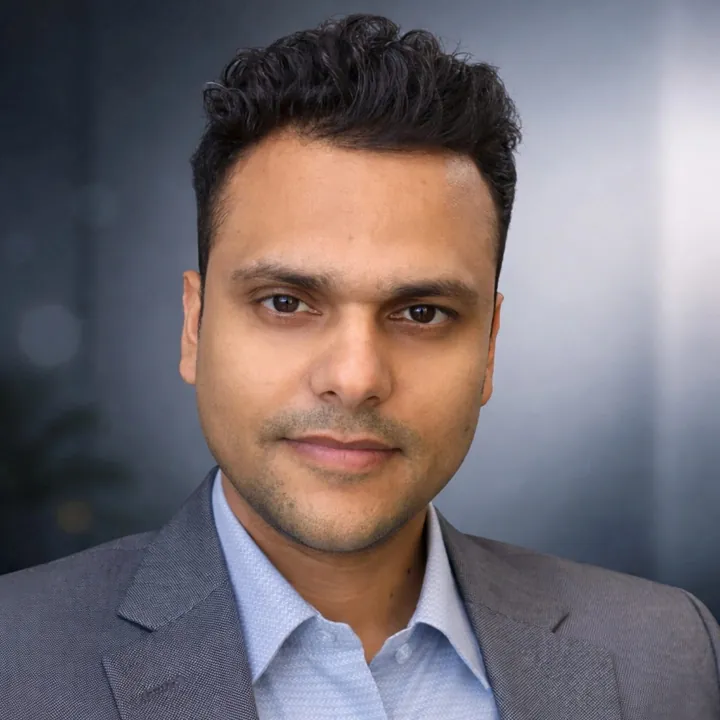
Ajay Vatsyayan (M.Tech, 14+ years teaching maths) teaches university maths online, one to one, from your own lecture notes, problem sheets and past papers. Calculus, linear algebra, differential equations, real analysis, probability and statistics, numerical methods and B.Tech M1–M3 are all covered, for students in India and at universities abroad.
1:1
Online sessions
14+ years
Teaching maths
Your syllabus
Planned from your course outline
I was strong at school maths, but my first university problem sheets take me hours and I still get them wrong.
I study abroad and want an Indian maths tutor who teaches online at a time that works in my time zone.
I'm a Master's student and my course assumes linear algebra and probability I never really learned.
Where it goes wrong
Why capable students struggle with university maths
Most students who contact us were good at school maths. The trouble starts when a course stops rewarding speed with familiar methods and starts asking why a method works, when it fails, and how to prove a statement nobody has shown you before. A single lecture can cover what a school would spread over a fortnight, and the problem sheet assumes you have filled the gaps yourself.
From teaching, the same few causes come up again and again, whatever the university or country:
- A shaky earlier course. Trouble with Calculus II or M2 often starts with algebra, trigonometric identities or integration skills that were never secure.
- Definitions treated as decoration. In linear algebra and real analysis, a proof usually comes straight out of the definition of span, limit or continuity; students who skip the definitions cannot start.
- Methods used without their conditions. The ratio test, L'Hôpital's rule or an integrating factor gets applied where it is not allowed, and the marks for the hypothesis line disappear.
- Notation overload. Vector calculus, probability and differential equations each bring new symbols; a missing dx, a wrong limit of integration or a confused P(A | B) can cost a whole question.
- Working alone for too long. Problem sheets pile up, and by mid-terms the backlog is a whole topic deep.
Sessions are built to fix those causes in order: first the gap underneath, then the current topic, then exam technique.
Topic map
Every course area Ajay teaches, and where marks are lost
This table is a map of the university maths Ajay teaches. The last column shows the kind of slip that costs students most often in exams for that area.
| Course area | What you learn | Where marks are lost |
|---|---|---|
| Single-variable calculus (Calculus I and II, M1) | Limits, derivatives, integration techniques, improper integrals, sequences and series | Choosing the wrong integration method; not testing the endpoints of a power series |
| Multivariable and vector calculus (Calculus III) | Partial derivatives, gradients, multiple integrals, line and surface integrals, Green, Stokes and divergence theorems | Wrong limits after changing to polar or spherical coordinates; a missing Jacobian |
| Linear algebra, computational | Systems of equations, matrices, determinants, eigenvalues, diagonalisation, least squares | Arithmetic slips in row reduction; eigenvectors that are never checked |
| Linear algebra, proof-based | Vector spaces, subspaces, bases, linear maps, rank–nullity, inner products | Calling a set a subspace without checking closure; mixing up a map and its matrix |
| Ordinary differential equations | First-order methods, second-order linear equations, systems, Laplace transforms | A wrong particular-solution guess when the forcing term repeats part of the complementary function |
| Fourier series and introductory PDEs | Fourier coefficients, separation of variables, heat and wave equations | Sign and parity errors in coefficients; boundary conditions applied too late |
| Real analysis | Sequences, series, continuity, differentiability, the Riemann integral, uniform convergence | Proofs that pick N or δ before analysing the inequality |
| Probability | Random variables, discrete and continuous distributions, expectation, conditional probability, Bayes' theorem | Confusing P(A | B) with P(B | A); a density that does not integrate to 1 |
| Statistics | Estimation, confidence intervals, hypothesis tests, regression basics | A conclusion stated without the hypotheses or the test conditions |
| Numerical methods | Root finding, interpolation, numerical integration, numerical solution of ODEs | Too few decimal places carried; no comment on convergence or error |
| Complex variables (B.Tech engineering maths) | Analytic functions, Cauchy–Riemann equations, contour integrals, residues | Counting a pole outside the contour; a wrong residue at a double pole |
| Transforms (B.Tech engineering maths) | Laplace and Fourier transforms and their use in solving equations | Losing the initial conditions when transforming derivatives |
Most students need three or four of these rows, not all twelve. The diagnostic in the first session shows which ones.
Choose your page
Course pages and country pages
Each course and each country has its own page with a full topic map, worked examples and notes on how that course is examined. Start with the one closest to what you are studying.
Engineering Mathematics M1, M2, M3
B.Tech maths semester by semester, including back papers, and numerical methods or probability where your syllabus includes them.
Engineering maths tutorIIT first-year maths
The jump from JEE problem solving to IIT calculus and linear algebra, where definitions and proofs start to matter.
IIT first-year mathsLinear algebra
Computation-heavy and proof-based courses, and the applications in machine learning, physics and differential equations.
Linear algebra tutorCalculus 3 (multivariable calculus)
Partial derivatives, multiple integrals and the theorems of vector calculus.
Calculus 3 tutorDifferential equations
First- and second-order ODEs, systems, Laplace transforms and a first look at PDEs.
Differential equations tutorReal analysis
Proof-based analysis: sequences, series, continuity, the Riemann integral and uniform convergence.
Real analysis tutorProbability and statistics
College and engineering probability, distributions, estimation, hypothesis tests and regression basics.
Probability and statistics tutorUS college calculus
Calculus I to III, linear algebra and differential equations, with session times worked out across US time zones.
US calculus tutorUK university maths
Year 1 modules on maths, engineering and science degrees, and the step up from A Level.
UK university mathsSweden
Calculus and linear algebra courses at KTH, Chalmers and other Swedish universities, with sessions in English.
Sweden university mathsSwitzerland
Analysis and linear algebra for the ETH first-year examinations and the EPFL first year, with sessions in English.
Switzerland university mathsStudying abroad with a tutor in India
Our guide to time zones, what to share and what to check before you start online sessions from abroad.
Read the guideCourse mapping
How your course name maps to what Ajay teaches
The same maths travels under many names. A student at a US college, a UK university, KTH or an Indian engineering college may be learning nearly the same calculus, yet the course codes, the order of topics and the weight given to proof all differ. The examples below come from the universities' own pages; always send us your own course code and outline.
- United States: the usual run is Calculus I, Calculus II, Calculus III or Multivariable Calculus, then Linear Algebra and Differential Equations. Some universities merge the last two; at UC Berkeley, Math 54 is Linear Algebra & Differential Equations, and the first two calculus courses are now Math 51 and 52 (formerly 1A and 1B).
- United Kingdom: at Imperial College London the first year is identical for every mathematics degree, with Analysis I, Linear Algebra and Group Theory, Calculus and Applications, and Probability and Statistics among its modules. Manchester's Year 1 units include Real Analysis, Linear Algebra, and ODEs and Applications.
- Sweden: KTH's first-year courses include SF1625 Calculus in One Variable, SF1624 Algebra and Geometry and SF1626 Calculus in Several Variables, each worth 7.5 credits.
- Switzerland: ETH Zurich's first-year examinations complete the first Bachelor's year, and EPFL's first-year study plans include MATH-101 Analyse I and MATH-111 Algèbre linéaire.
- India: B.Tech programmes usually split Engineering Mathematics into three courses, M1, M2 and M3, across the early semesters, each university with its own syllabus. IIT first-year maths covers calculus and linear algebra at a faster pace and with more theory.
Master's programmes rarely teach this maths again; they assume it. That is where many postgraduate students first notice the gap.
Worked examples
Three short examples from three course areas
Each example is the kind of question Ajay might work through with you in a first session. Try it on paper before reading the steps.
Differential equations: a second-order initial value problem
Solve y″ − 3y′ + 2y = 0 with y(0) = 1 and y′(0) = 0.
- Try y = e^(rt). Substituting gives the characteristic equation r² − 3r + 2 = 0.
- Factorise: (r − 1)(r − 2) = 0, so r = 1 or r = 2.
- General solution: y = A e^t + B e^(2t).
- Use y(0) = 1: A + B = 1.
- Differentiate: y′ = A e^t + 2B e^(2t). Use y′(0) = 0: A + 2B = 0.
- Subtract the first equation from the second: B = −1, so A = 2.
Answer: y = 2e^t − e^(2t)
Check: y(0) = 2 − 1 = 1 and y′(0) = 2 − 2 = 0. Students who stop at the general solution lose the marks for the initial conditions.
Numerical methods: Newton–Raphson
Use the Newton–Raphson method with x₀ = 1.5 to find the real root of x³ − x − 3 = 0, correct to 4 decimal places.
- Here f(x) = x³ − x − 3 and f′(x) = 3x² − 1. The iteration is xₙ₊₁ = xₙ − f(xₙ)/f′(xₙ).
- From x₀ = 1.5: f(1.5) = −1.125 and f′(1.5) = 5.75, so x₁ = 1.5 + 1.125/5.75 = 1.695652.
- From x₁: f(x₁) = 0.179749 and f′(x₁) = 7.625709, so x₂ = 1.672081.
- From x₂: f(x₂) = 0.002813 and f′(x₂) = 7.387563, so x₃ = 1.671700.
- The next iterate also rounds to 1.671700, so the value is stable to 4 decimal places.
Answer: x ≈ 1.6717
Carry at least six decimal places in the working. Rounding early is a common way to lose method marks.
Probability: a continuous random variable
X has density f(x) = 3x² for 0 ≤ x ≤ 1, and 0 otherwise. Find E(X), Var(X) and P(X > 1/2).
- Check it is a density: ∫ from 0 to 1 of 3x² dx = [x³] from 0 to 1 = 1.
- E(X) = ∫ from 0 to 1 of x · 3x² dx = [3x⁴/4] from 0 to 1 = 3/4.
- E(X²) = ∫ from 0 to 1 of x² · 3x² dx = [3x⁵/5] from 0 to 1 = 3/5.
- Var(X) = E(X²) − (E(X))² = 3/5 − 9/16 = 48/80 − 45/80 = 3/80.
- P(X > 1/2) = ∫ from 1/2 to 1 of 3x² dx = 1 − (1/2)³ = 7/8.
Answer: E(X) = 3/4, Var(X) = 3/80, P(X > 1/2) = 7/8
Master's students
The maths behind your course or project
Postgraduate programmes in engineering, data science, economics and physics often assume linear algebra, multivariable calculus, differential equations or probability at a level the student met years ago, or never met fully. A paper relies on eigen-decompositions, a methods course writes everything in gradients, or a project needs a differential equation solved numerically.
Ajay teaches the underlying maths so you can follow the method yourself: what the notation means, why the technique works, and how to check your own results. This is teaching only. Ajay does not write theses, dissertations or papers, and he does not run analyses or produce any assessed work for you.
How sessions work
From first message to final exam
Every session is online, on a shared screen, with handwritten working so Ajay can see each step and not just the answer.
1. Before session 1: send your materials
Share the course name and code, the syllabus or module outline, two or three recent problem sheets and any marked work, plus your exam dates and your time zone. WhatsApp or email is fine.
2. Session 1: a diagnostic, not a lecture
Ajay works through a few short questions with you and watches how you reason. By the end you both know which gap sits underneath the current trouble.
3. Weekly rhythm
Most students take one or two sessions a week, tied to the lecture calendar: the new topic is explained, you attempt problems while Ajay watches, and you leave with a short practice set. A regular time is fixed around your time zone.
4. Before mid-terms and finals
Sessions move to past papers under time limits, with a clear list of the question types where you still drop marks.
5. After the exam
If your course returns the script, go through it together, then plan the next course so the same gap does not open again.
Our usual approach
What the first month usually looks like
This is how a first month usually runs for a student who joins in the middle of a semester. It is our usual approach, not a promise; the pace depends on your course and the time you can give.
| Week | Focus | You leave with |
|---|---|---|
| Week 1 | Diagnostic, then the earliest gap (often algebra, integration or a key definition) | A short list of what to revise first, in order |
| Week 2 | Repairing that gap while keeping up with the current lectures | Worked notes in your own handwriting |
| Week 3 | The current problem sheet: you attempt, Ajay reviews | Corrected attempts and the reason behind each correction |
| Week 4 | Timed mixed questions from past papers | A topic-by-topic plan for the mid-term |
Time zones
Session times from India, wherever you study
Ajay teaches from India on Indian Standard Time (UTC+5:30), which has no daylight saving. The gap to your city changes when your own clocks change, so we agree times by your time zone and re-check them when the clocks move.
Home tuition is available in Gurgaon (Gurugram). Students elsewhere in India and abroad learn with us online.
| Where you study | IST ahead by, in winter | IST ahead by, in summer |
|---|---|---|
| United Kingdom (GMT / BST) | 5 h 30 min | 4 h 30 min |
| Sweden and Switzerland (CET / CEST) | 4 h 30 min | 3 h 30 min |
| US Eastern (EST / EDT) | 10 h 30 min | 9 h 30 min |
| US Pacific (PST / PDT) | 13 h 30 min | 12 h 30 min |
In practice, a UK or European afternoon falls in the Indian evening, while a US evening falls in the Indian early morning.
Fit
Who these sessions suit, and who they don't
Online one-to-one teaching works well for some students and is the wrong choice for others. It is better to know before you book.
- Suits first- and second-year students on maths, engineering, physics, economics or computing degrees who want to understand the methods, not memorise them.
- Suits students retaking a course or clearing a back paper who need the topic rebuilt from the start.
- Suits Master's students who need the maths behind their course or project explained.
- Suits students abroad who want an India-based tutor and can keep a regular slot in the Indian evening or morning.
- Doesn't suit anyone looking for someone to do graded work, sit an online test or write a thesis.
- Doesn't suit GATE preparation with Ajay: GATE engineering mathematics is taught by another Maths Bodhi tutor, so mention it when you enquire.
Academic integrity
What we will and won't do
Ajay explains concepts, sets practice questions and reviews the attempts you make yourself, including past papers and ungraded sheets. We do not complete graded assignments or coursework, take online tests, quizzes or exams on anyone's behalf, or write theses, dissertations or any other assessed work.
Universities treat that kind of help as misconduct, and it would leave you without the skill the next exam tests. If a sheet counts towards your grade, submit your own work, then bring similar practice questions and Ajay will teach the method on those.
Study guides
Free guides for this course
Worked examples and exam advice from the Maths Bodhi team, topic by topic.
Related Ajay routes
Continue with the most relevant next page
Engineering Mathematics M1, M2, M3
B.Tech maths, semester by semester.
IIT first-year maths
Calculus and linear algebra in the IIT first year.
Linear algebra tutor online
Matrices, vector spaces, eigenvalues and proofs.
Calculus 3 tutor online
Multivariable and vector calculus.
Differential equations tutor online
ODEs, systems, Laplace transforms and intro PDEs.
Real analysis tutor online
Proof-based analysis from sequences to uniform convergence.
Probability and statistics tutor online
Distributions, estimation and hypothesis tests.
US college calculus tutor online
Calculus I to III, linear algebra and ODEs for US colleges.
Book a demo session
See how Ajay teaches before you commit.
Main Ajay profile
Read Ajay's overall tutor profile.
FAQ
Questions students ask about online university maths tutoring
Can I have online university maths sessions if I live outside India?
Yes. All university sessions are online with a shared screen, so students in the US, UK, Europe and elsewhere join the same way. We agree a regular time that fits your time zone.
Which syllabus will the sessions follow?
Yours. Send your course outline, problem sheets and past papers, and sessions follow them, whether your course is B.Tech M2, Calculus III or a first-year analysis module.
Which university maths courses does Ajay teach?
Calculus, multivariable and vector calculus, linear algebra, differential equations, real analysis, probability and statistics, numerical methods, and B.Tech Engineering Mathematics M1, M2 and M3.
Can you help with proof-based courses like real analysis?
Yes. Ajay builds each proof from the definitions with you, then has you write the next one yourself and reviews it line by line.
How many sessions will I need?
It depends on how far behind you are and how soon the exam is. Most students start with one or two sessions a week, and the first-session diagnostic gives a clearer picture.
Do you teach GATE maths?
Not Ajay. GATE engineering mathematics is taught by another Maths Bodhi tutor; mention it when you enquire and we will put you in touch.
Can a Master's student get help with the maths in a project?
Yes, with understanding the maths your course or project relies on. Ajay teaches it; he does not write theses, run your analyses or produce assessed work.
What should I send before the first session?
Your course code and outline, recent problem sheets, any marked work, your exam dates and your time zone.
Will you do my assignment or online test?
No. We teach, practise and review your own attempts. We never complete graded work or sit tests for students.
Is there a trial session?
Yes. You can book a demo session on the website to check that Ajay's teaching style suits you before starting regular sessions.
Next step
Tell us your course and we will check the fit
Send your university, course name or code, the topics giving you trouble, your exam dates and your time zone. Maths Bodhi will confirm whether Ajay is the right tutor and suggest session times.