

IIT first-year maths, online
IIT first year maths tutor online: from JEE to calculus, linear algebra and ODEs
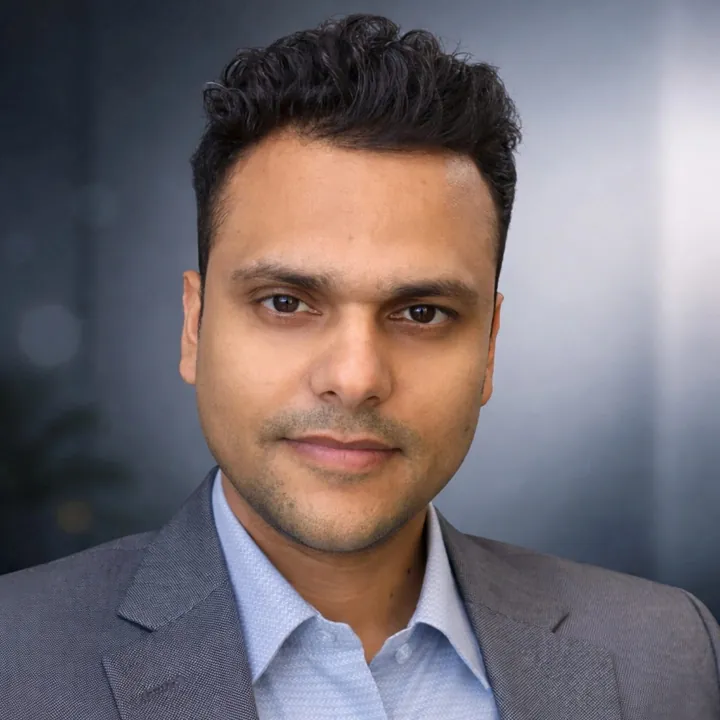
Ajay Vatsyayan teaches IIT first year maths one to one online, for students who were quick at JEE but find that institute courses now want definitions, justified steps and short proofs. Sessions follow your own course code and batch, at IIT Bombay, Delhi, Madras, Kanpur or any other institute, in step with lectures, tutorials and quizzes.
1:1
Online sessions
Course-code based
Planned from your batch's course
Quiz to end-sem
Paced to your institute calendar
I could do any JEE limit in thirty seconds, and now the quiz asks me to prove the limit exists from the definition.
My first linear algebra tutorial was about vector spaces over ℝ and ℂ, and I could not tell what the question even wanted.
My mid-semester marks in calculus were lower than I have ever scored in maths, and I want to fix it before the end-semester exam.
From JEE to IIT
What changes in IIT first year maths after JEE
JEE preparation trains recognition and speed: spot the type, pick the shortcut, move on. First-year IIT courses reverse the priorities. They define limits, convergence, continuity and linear independence exactly, then expect you to argue from those definitions. A quiz might ask why a series converges, whether a function is differentiable at a point, or whether a set is a subspace, and the marks go to the reasoning, not the final line.
The content also widens. Several-variable calculus, line and surface integrals, abstract vector spaces, linear maps and existence theorems for ODEs are largely new to students straight from JEE, and they arrive within the first two semesters. Strong JEE scorers often find the first mid-semester exam a shock. That is normal, and it is a skill gap, not an ability gap: writing a justified argument can be taught like any other technique.
Your institute's courses
First-year maths at IIT Bombay, Delhi, Madras and Kanpur, by batch
Each IIT numbers and splits its first-year maths differently, and several have changed codes recently. The table is taken from each department's official curriculum pages.
| IIT | Curriculum or batch | Course | Semester | What it covers |
|---|---|---|---|---|
| Bombay | Maths department curriculum booklet, Sep 2025 | MA 105 Calculus, 8 credits | First semester for B.S. Mathematics students who joined July 2023 or later; B.Tech: check your timetable | Limits to Taylor's theorem, Riemann integral, series, partial derivatives, Lagrange multipliers, multiple, line and surface integrals, Green, Gauss and Stokes |
| Bombay | Same booklet | MA 110 Linear Algebra and Differential Equations, 8 credits | Second semester (B.S. Mathematics) | Vector spaces, rank–nullity, Gram–Schmidt, least squares, eigenvalues, spectral theorem; first-order and linear ODEs, variation of parameters, Laplace basics |
| Bombay | Half-semester versions (2023 course list) | MA 109 Calculus 1 and MA 111 Calculus 2; MA 106 Linear Algebra and MA 108 Differential Equations; 4 credits each | Check your timetable | Together, the content of MA 105 and MA 110 |
| Delhi | Curriculum 2025 onwards (new four-digit codes) | MTL1001 Mathematics I Calculus, 4 credits | Sem 1 (B.Tech CSE schedule) | Completeness and Cauchy sequences, series tests, MVT and Taylor, Riemann and improper integrals, beta and gamma, several-variable calculus, multiple and surface integrals |
| Delhi | Curriculum 2025 onwards | MTL1002 Mathematics II Linear Algebra and Differential Equations, 4 credits | Sem 2 (B.Tech CSE schedule) | Vector spaces over Q, R and C, linear maps, change of basis, Cayley–Hamilton; Picard's theorem, Wronskian, variation of parameters, systems of ODEs, Laplace transform |
| Madras | 2024 batch onwards | MA1101 Calculus, 12 credits, mandatory | Not stated on the department page | Functions of two and three variables, Lagrange multipliers, multiple integrals in polar, cylindrical and spherical form, Taylor and Fourier series |
| Madras | 2024 batch onwards | Listed electives: MA2101 Linear Algebra via Matrices, MA2102 Differential Equations, MA2103 Probability, Stochastic Process and Statistics, MA2104 Complex Variables; 9 credits each | Not stated | Linear algebra, ODEs, probability and complex variables as separate courses |
| Madras | Up to 2023 batch | MA1101 Functions of Several Variables, 12 credits | Semester 1 | Multivariable and vector calculus, Green, Gauss and Stokes |
| Madras | Up to 2023 batch | MA1102 Series and Matrices, 12 credits | Semester 2 | Sequences, power and Fourier series, matrices, rank, Gaussian elimination, eigenvalues, diagonalisation |
| Kanpur | Courses of Study 2026 | MTH111M Single Variable Calculus; MTH112M Application of Single Variable Calculus & Several Variable Calculus; 6 credits each | Semester 1 | Completeness, sequences, MVT, Taylor, series, Riemann integration, trapezoidal and Simpson's rules; then curvature, partial derivatives, Lagrange multipliers, line and surface integrals, Green, Stokes, divergence |
| Kanpur | Courses of Study 2026 | MTH113M Introduction to Linear Algebra; MTH114M Introduction to Ordinary Differential Equations; 6 credits each | Semester 2 | Vector spaces, rank–nullity, Gram–Schmidt, least squares, symmetric matrices; Picard, Euler's method, Wronskian, Frobenius, Legendre, Bessel, Sturm–Liouville, Laplace |
Codes change between batches, so check the code and batch on your own registration before relying on this table. At IIT Madras the code MA1101 means Functions of Several Variables up to the 2023 batch and Calculus from 2024, and IIT Kanpur's programme templates print the codes as MTH 111 to MTH 114. If your transcript shows a code not listed here, you are probably on an earlier curriculum: send us the course outline.
None of these four IITs has complex analysis in the first-year courses above; at Madras, Complex Variables appears only among the listed electives. Laplace transforms sit inside the ODE courses at Bombay, Delhi and Kanpur, and Fourier series appear in first year only at Madras.
Topic map
JEE habits against IIT expectations, topic by topic
The topics overlap with JEE more than students expect. What changes is the question being asked about them.
| Topic | What JEE practice trained | What first-year courses ask | Where marks are lost |
|---|---|---|---|
| Limits | Evaluate quickly by expansion or L'Hôpital | Prove a limit from the ε–δ definition, or show one does not exist | Using L'Hôpital where its conditions fail |
| Sequences and series | Sum an AP, GP or telescoping series | Decide convergence with a named test; completeness and Cauchy sequences | Ratio test when the limit is 1; checking only that terms tend to 0 |
| Mean value and Taylor theorems | Quote the result | Use them in proofs; bound the Taylor remainder | Not checking continuity and differentiability first |
| Integration | Tricks and definite-integral properties | Riemann sums, improper integrals, beta and gamma | Treating an improper integral as ordinary |
| Several-variable calculus | Mostly new | Partial and directional derivatives, differentiability, Lagrange multipliers | Assuming existing partial derivatives mean differentiable |
| Multiple and vector integrals | Area under a curve | Double and triple integrals, Jacobians, Green, Stokes and Gauss | Missing the Jacobian; wrong orientation |
| Matrices to linear algebra | 3 × 3 determinants and inverses | Vector spaces, linear maps, rank–nullity, eigenvalues, diagonalisation | Computing when the question says 'prove' |
| Differential equations | Separable and linear first-order equations | Existence and uniqueness, Wronskian, variation of parameters, Laplace | Not stating the interval of the solution |
| Numerical ideas | Rarely met | Picard and Newton iteration, Euler's method, trapezoidal and Simpson's rules (Kanpur) | Iterating without checking the error |
Where students get stuck
Why strong JEE scorers lose marks in first-year quizzes
The commonest pattern is a correct answer with no justification. A student finds the limit, sums the series or solves the ODE, and loses most of the marks because the question asked them to show that something is true. The second pattern is a theorem used outside its conditions: the ratio test applied when the limit is 1, or L'Hôpital used where the function is not differentiable.
The third is pace. Lectures move quickly, tutorial sheets pile up, and a student who falls behind by two weeks finds the next topic built on the one they skipped. We catch up by working through definitions as tests you can run, then doing the tutorial problems with you writing every line, until justified answers become the default.
Worked examples
Three first-year problems where the method alone is not enough
Original problems in the style of an IIT quiz or mid-semester paper, with the reasoning written out.
Convergence of a series by comparison
Decide whether Σ (√(n + 1) − √n)/n, for n from 1 to ∞, converges. Justify your answer.
- Rationalise: √(n + 1) − √n = 1/(√(n + 1) + √n), so the nth term is aₙ = 1/(n(√(n + 1) + √n)) > 0.
- Since √(n + 1) + √n ≥ 2√n, we get 0 < aₙ ≤ 1/(2n^(3/2)) for every n ≥ 1.
- Σ 1/n^(3/2) is a p-series with p = 3/2 > 1, so it converges, and so does Σ 1/(2n^(3/2)).
- By the comparison test, Σ aₙ converges.
- Cross-check by limit comparison: aₙ ÷ (1/n^(3/2)) = √n/(√(n + 1) + √n) → 1/2, a finite positive limit.
Answer: The series converges, by comparison with Σ 1/(2n^(3/2)).
The ratio test gives the limit 1 here and decides nothing. Saying so earns credit; stopping there loses the question.
Partial derivatives exist, but the function is not continuous
Let f(x, y) = xy/(x² + y²) for (x, y) ≠ (0, 0) and f(0, 0) = 0. Show that both partial derivatives exist at (0, 0), but f is not continuous there.
- fₓ(0, 0) = lim as h → 0 of (f(h, 0) − f(0, 0))/h = lim (0 − 0)/h = 0. By symmetry f_y(0, 0) = 0, so both partial derivatives exist.
- Approach the origin along the line y = mx with x ≠ 0: f(x, mx) = mx²/(x² + m²x²) = m/(1 + m²).
- This value depends on m: along y = 0 it is 0, along y = x it is 1/2.
- A limit must be the same along every path, so the limit of f at (0, 0) does not exist and f is not continuous at the origin.
- Since differentiability implies continuity, f is not differentiable at (0, 0) either.
Answer: fₓ(0, 0) = f_y(0, 0) = 0, but f has no limit at (0, 0), so it is neither continuous nor differentiable there.
In one variable a derivative forces continuity. In two variables it does not, and quizzes test exactly this.
Variation of parameters
Solve y″ + y = sec x on −π/2 < x < π/2 with y(0) = 1 and y′(0) = 0.
- Homogeneous solutions: y₁ = cos x and y₂ = sin x. The Wronskian is W = cos x · cos x − sin x · (−sin x) = 1.
- Write yₚ = u₁y₁ + u₂y₂ with u₁′ = −y₂ sec x / W = −tan x and u₂′ = y₁ sec x / W = 1.
- Integrate: u₁ = ln(cos x), valid because cos x > 0 on the interval, and u₂ = x.
- So yₚ = cos x ln(cos x) + x sin x, and y = C₁ cos x + C₂ sin x + cos x ln(cos x) + x sin x.
- y(0) = C₁ = 1. Differentiating, y′(0) = C₂ + 0, so C₂ = 0.
- Check: substituting yₚ back gives yₚ″ + yₚ = sec x.
Answer: y = cos x + cos x ln(cos x) + x sin x, for −π/2 < x < π/2
Undetermined coefficients cannot handle sec x. State the interval, because ln(cos x) needs cos x > 0.
First semester
Our usual plan for the first semester
This is how we usually pace a student who starts with us early in the semester. It is our usual approach, not a promise, and we move it to match your course calendar and topic order.
| Stage | Focus | Aim |
|---|---|---|
| First weeks | Real numbers, sequences, limits from the definitions | Write a correct short proof without prompting |
| Before the first quiz | Series tests, continuity, mean value theorem | Choose the right test and say why the others fail |
| Up to the mid-semester exam | Taylor's theorem, integration, past quizzes under time | Full marks on the method and the justification |
| After the mid-semester exam | Several-variable calculus and multiple integrals | Keep pace with lectures, not catch up |
| Before the end-semester exam | Mixed past papers and a sheet of definitions and theorems | State each result exactly and use it correctly |
How sessions work
How online sessions fit around an IIT timetable
Sessions run online on a shared screen with handwritten working, at times agreed around your lectures, labs and time zone; many first-year students choose evenings or weekends.
1. Share your course
Course code and batch, the course outline, lecture slides or notes, tutorial sheets, past quizzes and the dates of quizzes and exams.
2. First session
Ajay asks you to solve one problem and justify one claim. How you write the second shows where to start.
3. Weekly
This week's lecture topic: the definition, why each theorem needs its conditions, then tutorial-style problems you write out in full.
4. Quiz and exam weeks
Past quizzes under time, a one-page list of definitions and theorems, and a review of how you present proofs.
5. After grades
We go through the marked paper and plan for the next course, whether that is linear algebra, ODEs or a second-year elective.
Fit
Who this is for, and who it is not
It is for first-year students at any IIT, and at NITs, IIITs and other institutes whose first-year maths covers the same calculus, linear algebra and ODE ground; sessions follow your own course outline. Ajay (M.Tech, 14+ years teaching maths) teaches all of it, including the short proofs these courses ask for.
It is not for students who want quizzes taken or graded work done for them. Students still preparing for JEE Advanced should see Ajay's JEE page instead. Home tuition is available in Gurgaon (Gurugram). Students elsewhere in India and abroad learn with us online.
Still preparing for JEE?
JEE Advanced maths with Ajay, for students before the exam.
JEE Advanced maths tutorFurther reading
Our guide to the jump from JEE to the first semester at an IIT.
From JEE to IIT first-year mathsAcademic integrity
Teaching your own work, never doing it
We explain the course, set practice and review attempts the student has written. We do not complete graded assignments or tutorial submissions, take quizzes, online tests or exams on anyone's behalf, or write assessed reports or theses. If a graded problem comes up, Ajay teaches the idea through a similar problem and the student writes their own answer.
Study guides
Free guides for this course
Worked examples and exam advice from the Maths Bodhi team, topic by topic.
Related Ajay routes
Continue with the most relevant next page
University maths tutor online
All university courses Ajay teaches.
Engineering mathematics tutor
M1, M2 and M3 at AKTU, VTU, Mumbai, Anna and more.
Linear algebra tutor online
Vector spaces, linear maps and eigenvalues.
Calculus 3 tutor online
Several-variable and vector calculus.
Differential equations tutor online
From first-order equations to Laplace transforms.
Real analysis tutor online
For students who want the proofs behind calculus.
Book a free demo class
Bring a quiz question you lost marks on.
Ajay Vatsyayan
Profile and every course he teaches.
FAQ
Questions students ask about IIT first year maths tutoring
I did very well in JEE maths. Why am I struggling in first-year maths at IIT?
Because the courses now mark the reasoning, not just the answer. Justifying steps and writing short proofs is a separate skill, and it improves quickly with focused practice.
Do you follow my IIT's course or a general syllabus?
Your course. Send the code, batch, outline and tutorial sheets, and sessions follow your lectures topic by topic.
My course code isn't in your table. Can you still help?
Yes. Codes change between batches and institutes. Send the course outline and we plan from that.
Is complex analysis part of IIT first-year maths?
Not in the first-year courses we checked at IIT Bombay, Delhi, Madras and Kanpur. If your course includes it, send the outline and we will cover it.
Can you help with tutorial sheets?
Yes, for practice: we work through similar problems and review your own attempts. We do not write anything you submit for marks.
Do you teach NIT and IIIT students too?
Yes. First-year maths at most engineering institutes covers similar ground, and sessions follow your own outline.
When should I start?
As soon as the first tutorial feels unclear. Catching up after the mid-semester exam is possible, but starting in the first weeks is far easier.
How many sessions a week do students usually take?
Usually one or two, with extra sessions in the fortnight before a quiz or exam.
Is there a demo session?
Yes. Book a demo and bring a quiz or tutorial problem you found hard; Ajay will work through it with you.
Next step
Share your course code and batch
Tell us your institute, batch, course code, quiz and exam dates and time zone, and attach the course outline. Maths Bodhi will check the fit with Ajay and suggest session times.