

B.Tech M1, M2 and M3, online
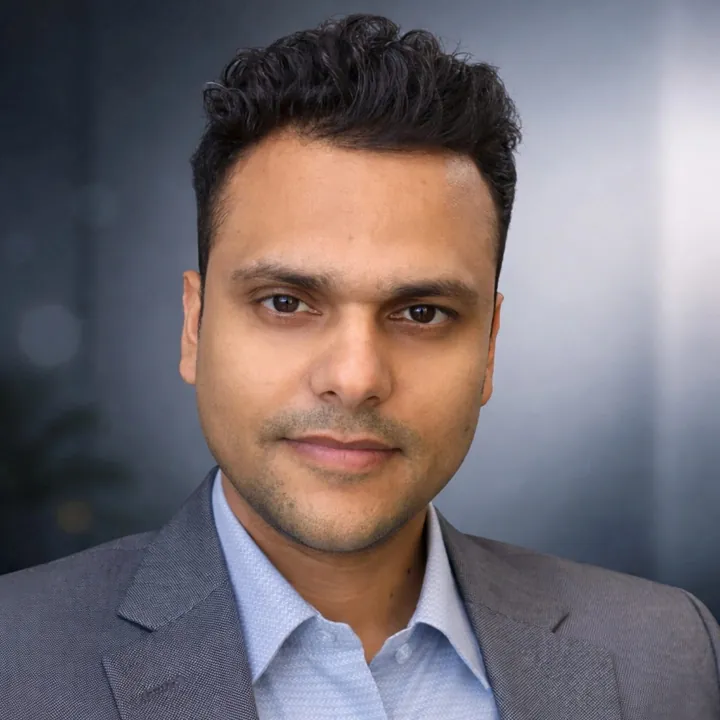
Engineering mathematics tutor online for B.Tech M1, M2 and M3: Ajay Vatsyayan
Ajay Vatsyayan teaches B.Tech engineering mathematics one to one online, paper by paper: calculus and matrices in the first semester, ODEs, transforms and complex variables after that, and the numerical methods and statistics papers many schemes add. Sessions follow the exact scheme on your marksheet, and back papers get a plan built from past university questions.
1:1
Online sessions
Scheme-wise
Planned from the code on your marksheet
Back papers
Past-paper plan for a re-attempt
My Sem II paper is called 'Numerical Methods' but the syllabus is all Laplace, complex analysis and ODEs, and I don't know how to prepare for it.
I have an M2 back paper to clear while I sit my third-semester papers, and I keep running out of time on the long questions.
School maths was fine, but five units of new technique a semester is more than I can keep up with alone.
What your university calls it
M1, M2 and M3 under their real names: AKTU, VTU, Mumbai, Anna and the AICTE model
Students say M1, M2 and M3; marksheets don't. Each university prints its own code and title, and several have brought in new schemes recently, so two students in one college can sit different maths papers depending on the year they joined. The table comes from each scheme's official syllabus PDFs.
| University and scheme | Sem I paper | Sem II paper | Later papers or variants |
|---|---|---|---|
| AKTU, new first year w.e.f. 2026-27, CSE stream (CSE, IT, AI, data science and allied) | AAS103D Calculus and Linear Algebra | AAS203D, titled Numerical Methods; units: higher-order ODEs, complex analysis, Laplace, Fourier series and transform, applied linear algebra | See AKTU's syllabus page |
| AKTU, w.e.f. 2026-27, ME stream | AAS103B Differential Calculus and Linear Algebra | AAS203B Multivariable Calculus and Numerical Methods; units: ODEs, Laplace, series, complex variables | See AKTU's syllabus page |
| AKTU, w.e.f. 2026-27, ECE stream | AAS103C Differential Calculus and Linear Algebra | AAS203C Calculus, Laplace Transform and Numerical Techniques | See AKTU's syllabus page |
| AKTU common first year, effective from 2022-23 (earlier batches) | BAS103 Engineering Mathematics-I | BAS203 Engineering Mathematics-II | 2023-24 second-year scheme: Mathematics-III for civil and allied; Mathematics-IV for computer, electronics, electrical, mechanical and allied |
| VTU 2025 scheme, CSE stream | 1BMATS101 Calculus and Linear Algebra | 1BMATS201 Numerical Methods | Not listed here |
| VTU 2025 scheme, Mechanical stream | 1BMATM101 Differential Calculus and Linear Algebra | 1BMATM201 Multivariable Calculus and Numerical Methods | Not listed here |
| VTU 2025 scheme, EEE stream | 1BMATE101 Differential Calculus & Linear Algebra | 1BMATE201 Calculus, Laplace Transforms and Numerical Techniques | Not listed here |
| VTU 2025 scheme, Civil stream | 1BMATC101 Differential Calculus and Linear Algebra | 1BMATC201 Differential Calculus and Numerical Methods | Not listed here |
| Mumbai University, NEP 2020: FE from 2024-25 (checked for CSE-AIML and EXTC) | BSC101 Applied Mathematics-I | BSC201 Applied Mathematics-II | SE from 2025-26, Sem III, by branch: 2113111 Mathematics for Computer Engineering; 2403111 Engineering Mathematics-III (Mechanical); 2303111 Mathematics for Signal Analysis (EXTC) |
| Anna University, Regulations 2021 (non-autonomous affiliated colleges) | MA3151 Matrices and Calculus | MA3251 Statistics and Numerical Methods | MA3351 Transforms and Partial Differential Equations (Sem III, e.g. Mechanical) |
| Anna University, Regulations 2025 (non-autonomous affiliated colleges) | MA25C01 Applied Calculus | MA25C02 Linear Algebra | By branch, e.g. MA25C09 Computational Differential Equations (Sem III, Mechanical); MA25C13 Probability and Statistics (Sem IV, CSE Data Science) |
| AICTE Model Curriculum, first year (November 2017), a model universities adapt | BSC103 Maths-1: Calculus and Linear Algebra | BSC104 Maths-2: Calculus, Ordinary Differential Equations and Complex Variable | CSE variants: BSC105 Calculus and Linear Algebra; BSC106 Probability and Statistics |
Check your own scheme before trusting any table, this one included: codes change whenever a university revises its curriculum, and older batches keep their old codes. VTU 2025-scheme codes start with a 1 (1BMATS101); Anna students under Regulations 2025 have MA25C codes, not MA3151. Autonomous colleges follow their own syllabus.
One trap needs its own line. AKTU's AAS203D is titled Numerical Methods, yet none of its five units is classical numerical methods, so prepare from the unit list, not the title. AKTU's second-year Mathematics-III and IV codes are also printed differently in the scheme table and the syllabus PDF; read yours off your marksheet.
Topic map
The engineering maths topic map: where each topic sits and where marks slip
Whatever the code, the papers draw on one pool of topics. The second column shows where each appears in the schemes above; the last is what we see most on marked scripts.
| Topic | Where it usually sits | Typical question | Where marks are lost |
|---|---|---|---|
| Matrices: rank, systems, eigenvalues, Cayley–Hamilton | First year everywhere, sometimes as a linear algebra paper | Rank by echelon form; consistency; A⁻¹ through Cayley–Hamilton | Row-operation slips; solving before testing consistency |
| Several-variable calculus | First year | Euler's theorem; Jacobians; maxima and minima; Lagrange multipliers | Skipping the second-derivative test |
| Multiple integrals | First year | Change the order of integration; convert to polar | Wrong limits; no sketch of the region |
| Beta and gamma functions | AKTU first year, VTU Sem II (Civil, Mechanical, EEE), Mumbai BSC201, AICTE BSC103; not Anna first year | Reduce an integral to β(m, n) or Γ(n) | Forcing the wrong standard form |
| Vector calculus | AKTU first year, VTU, AICTE | Directional derivative; verify Green's or Gauss's theorem | Wrong orientation or outward normal |
| Higher-order linear ODEs | First year at AKTU, VTU, Mumbai; Anna R2025 Sem III | Constant coefficients; Cauchy–Euler; variation of parameters | Wrong trial form when the right side matches a root |
| Laplace transform | AKTU Sem II (both schemes), VTU 1BMATE201, Mumbai SE (Mechanical, EXTC) | Periodic or unit-step function; solve an initial value problem | Partial fractions; shifting-theorem signs |
| Fourier series | AKTU Sem II (CSE, ECE, BAS203), Anna MA3351, Mumbai SE, AICTE BSC103 | Full- or half-range series; sum a numerical series | Not checking odd or even; losing a₀/2 |
| Complex variables | AKTU Sem II (both schemes), AICTE BSC104, Mumbai SE Mechanical | Milne–Thomson; Cauchy's formula; real integrals by residues | Counting a pole outside the contour |
| Partial differential equations | Mostly second year (AKTU Maths-III/IV, Anna MA3351, MA25C09, Mumbai Mechanical); VTU 1BMATC201 | Lagrange's linear equation; heat or wave equation by separation of variables | Boundary conditions in the wrong order |
| Numerical methods | VTU Sem II (all four streams), Anna MA3251, Mumbai FE, AKTU Maths-III | Newton–Raphson, interpolation, Simpson's rules, Runge–Kutta | Too few decimals; no table of working |
| Probability and statistics | Anna MA3251 and MA25C13, AKTU Maths-IV, Mumbai SE (Computer, EXTC), AICTE BSC106 | Curve fitting; binomial, Poisson, normal; t, Z or chi-square tests | Wrong degrees of freedom; wrong tail |
Where students get stuck
Why B.Tech maths papers go wrong for students who liked school maths
The difficulty is rarely one hard idea. It is volume: five units a semester, each with its own technique, at a pace that leaves little practice time. Recognising a method is not the same as finishing a ten-mark question with every line the examiner wants.
Later papers also lean on earlier ones. Laplace questions are lost in partial fractions, Fourier coefficients in integration by parts, residue questions in factorising a quadratic in z. A student who scraped through M1 often struggles in M2 for reasons that have nothing to do with M2, so Ajay's diagnostic looks for those gaps first.
Then there is layout. Method marks go to a stated theorem, correct limits and a check; we practise writing answers the way your university's model solutions are set out.
Numerical methods and statistics
Numerical methods and probability: which paper they are in
These topics move between schemes, sometimes under misleading titles. VTU's 2025 scheme puts numerical methods into all four stream-wise Sem II papers, and the CSE stream's 1BMATS201 is almost entirely numerical, from root finding and LU decomposition to interpolation and Runge–Kutta. Anna's MA3251 (Regulations 2021) pairs hypothesis testing and design of experiments with a numerical-methods half. Mumbai's Applied Mathematics-I and II each carry a numerical-methods module.
Probability usually comes later: AKTU's Mathematics-IV covers random variables, the binomial, Poisson and normal distributions and t, Z and chi-square tests, while Mathematics-III has curve fitting and two numerical-techniques modules instead. Anna's Regulations 2025 has a separate Probability and Statistics paper for CSE Data Science. These papers reward a tidy table of working and the right decimal places, so that is what we drill.
Worked examples
Three engineering mathematics questions, solved the way examiners mark them
Original end-semester-style questions from Fourier series, complex variables and numerical methods.
Fourier series of |x| and a series sum
Find the Fourier series of f(x) = |x| on (−π, π), and deduce the value of 1 + 1/3² + 1/5² + ….
- f is even, so every bₙ = 0 and only cosine terms remain.
- a₀ = (2/π)∫₀^π x dx = (2/π)(π²/2) = π, so the constant term is a₀/2 = π/2.
- aₙ = (2/π)∫₀^π x cos nx dx. By parts, ∫₀^π x cos nx dx = [x sin nx / n]₀^π + [cos nx / n²]₀^π = ((−1)ⁿ − 1)/n².
- So aₙ = 2((−1)ⁿ − 1)/(πn²): zero for even n, −4/(πn²) for odd n.
- Hence |x| = π/2 − (4/π)(cos x + cos 3x/3² + cos 5x/5² + …).
- At x = 0, where f is continuous and f(0) = 0: 0 = π/2 − (4/π)(1 + 1/3² + 1/5² + …), so the bracket equals π²/8.
Answer: |x| = π/2 − (4/π)(cos x + cos 3x/9 + cos 5x/25 + …), and 1 + 1/9 + 1/25 + … = π²/8
Say f is even before you start; it halves the integration and earns a mark.
A real integral by the residue theorem
Evaluate ∫ from 0 to 2π of dθ/(5 + 4 cos θ) by contour integration.
- Put z = e^(iθ) on |z| = 1. Then cos θ = (z + 1/z)/2 and dθ = dz/(iz).
- 5 + 4 cos θ = 5 + 2(z + 1/z) = (2z² + 5z + 2)/z = (2z + 1)(z + 2)/z.
- The integral becomes ∮ dz / (i(2z + 1)(z + 2)) around |z| = 1.
- Poles at z = −1/2 and z = −2; only z = −1/2 lies inside the unit circle.
- Residue at z = −1/2: 1/(i · 2 · (−1/2 + 2)) = 1/(3i).
- By the residue theorem the integral is 2πi × 1/(3i) = 2π/3.
Answer: 2π/3 (≈ 2.0944)
State which poles are inside and why; including z = −2 loses the question.
One step of the fourth-order Runge–Kutta method
Given dy/dx = x + y with y(0) = 1, use the fourth-order Runge–Kutta method with h = 0.1 to find y(0.1). Compare with the exact solution y = 2eˣ − x − 1.
- k₁ = h f(0, 1) = 0.1 × 1 = 0.1.
- k₂ = h f(0.05, 1.05) = 0.1 × 1.1 = 0.11.
- k₃ = h f(0.05, 1.055) = 0.1 × 1.105 = 0.1105.
- k₄ = h f(0.1, 1.1105) = 0.1 × 1.2105 = 0.12105.
- y(0.1) ≈ 1 + (0.1 + 0.22 + 0.221 + 0.12105)/6 = 1 + 0.66205/6 = 1.1103417.
- Exact: 2e^0.1 − 0.1 − 1 = 1.1103418, an error of about 2 × 10⁻⁷.
Answer: y(0.1) ≈ 1.110342, matching the exact value to six decimal places
Put the four k values in a table; each one carries marks.
Back papers
Clearing a back paper in M1, M2 or M3
A back paper is cleared by preparing for the university's question pattern, not by re-reading the textbook. We collect recent papers for your exact code, list the long questions that recur, and secure those first. If you are also sitting a current semester, we split the week so neither slips, and we check whether the re-attempt follows the scheme you first sat or a revised one.
Back-paper guide
A step-by-step plan for a re-attempt built from past papers.
How to clear an engineering maths back paperLaplace transforms
The transforms question types that recur, with the method for each.
Laplace transforms exam guideHow sessions work
How online engineering maths sessions run
Sessions are one to one on a shared screen, with handwritten working so Ajay sees each line. Times are agreed by your time zone and college timetable.
1. Before session 1
Send your university, branch, scheme year, the syllabus for your paper, two or three recent question papers, internal marks and the exam date.
2. The diagnostic
A short mixed test: a matrix question, a partial-derivative question and one from your current unit. It shows whether the trouble is the new topic or an older gap.
3. Each week
One unit: the method, a fully written model answer, then timed past-paper questions you attempt while Ajay corrects.
4. Before internals and end-semester
Full past papers under time, a formula sheet you build yourself, and a check of long-answer layout.
5. After the result
We read the marks unit by unit and decide whether to stop, move to your next maths paper, or prepare a re-attempt.
Exam run-in
Our usual four-week run-in to an end-semester maths paper
Our usual starting plan for a student who comes a month before the paper. It is a typical approach, not a promise, and shifts to fit your syllabus.
| Week | Focus | By the end of the week |
|---|---|---|
| 1 | Diagnostic and the two highest-weight units | Their recurring long questions done without notes |
| 2 | Remaining units, method first | One clean model answer per question type |
| 3 | Mixed past papers under time | Two full papers finished in time |
| 4 | Weak spots, formula sheet, layout | A final paper marked against the university pattern |
Fit
Who this suits, and who should look elsewhere
It suits B.Tech and B.E. students in their first two years at any university, students on a new scheme whose seniors' notes no longer match, and students clearing a back paper. Ajay (M.Tech, 14+ years teaching maths) teaches every paper on this page, including numerical methods and probability and statistics.
It is not for anyone wanting internal assignments written or an online test sat for them. GATE engineering mathematics is taught by another Maths Bodhi team tutor, not Ajay, so ask us for that tutor if GATE is your goal. Home tuition is available in Gurgaon (Gurugram). Students elsewhere in India and abroad learn with us online.
Academic integrity
What we teach, and what we will not do
Sessions explain methods, set practice and review attempts the student has made. We do not complete graded assignments, internal tests or lab records, take online tests or exams for anyone, or write project reports or theses that will be assessed. For a graded question, Ajay teaches the method on a parallel problem and the student writes the submitted answer.
Study guides
Free guides for this course
Worked examples and exam advice from the Maths Bodhi team, topic by topic.
Related Ajay routes
Continue with the most relevant next page
University maths tutor online
Every university course Ajay teaches.
IIT first-year maths
Calculus, linear algebra and ODEs at the IITs.
Linear algebra tutor online
Beyond rank and eigenvalues: vector spaces and proofs.
Calculus 3 tutor online
Multiple integrals and vector calculus in depth.
Differential equations tutor online
ODEs, Laplace transforms and an introduction to PDEs.
Probability and statistics tutor
Distributions, estimation and hypothesis tests.
Book a free demo class
Bring your syllabus and one past paper.
Ajay Vatsyayan
Profile and all courses.
FAQ
Questions students ask about engineering mathematics tutoring
Do you follow my university's syllabus or a general course?
Your university's. Send the syllabus for your exact paper code and scheme, and sessions follow its units in order.
My paper code is different from my seniors'. Does that matter?
Yes. Several universities have new schemes, and units can differ even when titles look alike. We plan from the code on your own marksheet.
Can you help me clear a back paper?
Yes. The plan comes from your university's past papers, starting with the long questions that recur most, and fits around your current semester.
Do you teach numerical methods and probability and statistics?
Yes, whether they sit in a first-year paper such as VTU's or Anna's, or in a second-year paper such as AKTU Mathematics-III or IV.
Do you teach GATE engineering mathematics?
GATE is taught by another Maths Bodhi team tutor, not Ajay. Mention it when you enquire and we will connect you.
How many sessions will I need for one paper?
Most students book one or two a week through the semester; someone starting close to the exam may book more for three or four weeks.
I study abroad and have an engineering maths module. Can I join?
Yes. Sessions are online at times agreed by your time zone. Send the module outline and we match its topics.
Is there a demo session?
Yes. Book a demo, bring your syllabus and one past paper, and Ajay will work through a question from it with you.
Will you solve my internal assignment?
No. We teach the method on similar questions and review your own attempts; we never complete graded work.
Next step
Send your paper code and syllabus
Tell us your university, branch, scheme year, paper code, exam date and time zone, and attach a recent question paper. Maths Bodhi will check the fit with Ajay and suggest session times.